
How Japan Works
Japan in January: Weather, What to Wear, and What Japanese People Say About the Month
Key Takeaways:
- By average temperature, January is the coldest month of the year in all twelve cities we list, from Sapporo to Naha. Tokyo averages 9.8°C (50°F) in the afternoon and 1.2°C (34°F) in the early morning, Kyoto 9.1°C and 1.5°C, Sapporo -0.4°C and -6.4°C, and Naha 19.8°C and 14.9°C (Japan Meteorological Agency averages for 1991 to 2020)
- January is also Tokyo's sunniest month, with 192.6 hours of sunshine on average, and the month with its lowest average humidity, 51%. Snow falls on 2.8 days of an average January in Tokyo and on 29.1 in Sapporo
- On clothes, 13 of 51 posts by Japanese people about what they wear in January say it is warm or too warm indoors, on trains or at work. For Sapporo, five of the seven replies we collected to one question about clothes for mid-January say to wear boots, or shoes with soles made for snow and ice
- In 2025, rooms at hotels and inns across Japan were 54.6% occupied in January, the lowest of any month (Japan Tourism Agency). Of 49 posts by Japanese people about travelling in January, 22 are glad of a January trip or recommend one, and 11 of those 22 say the places the writers visited were quiet
- National government offices and banks reopen on Monday 4 January 2027 after the New Year holidays. Coming of Age Day is Monday 11 January 2027
What is Japan like in January? By average temperature it is the coldest month of the year in all twelve cities we list, from Sapporo to Naha, and in Tokyo the sunniest. We collected 251 public posts by Japanese people about January: what they wear, travelling after the New Year holidays, Coming of Age Day, and the customs of the month.
Quick Guide
| Topic | In short |
|---|---|
| Weather | Tokyo: high 9.8°C and low 1.2°C on average. Kyoto: 9.1°C and 1.5°C. Sapporo: -0.4°C and -6.4°C. Naha: 19.8°C and 14.9°C |
| Sun and snow | Tokyo averages 192.6 hours of sun, more than in any other month. Kanazawa averages 62.3 hours and 256.0 mm of rain and snow. Snow falls on 2.8 days in Tokyo, 16.3 in Kyoto and 29.1 in Sapporo in an average January |
| What to wear | 13 of 51 posts say it is warm or too warm indoors, on trains or at work. Five of the seven replies we collected to one question about clothes for Sapporo in mid-January say to wear boots, or shoes with soles made for snow and ice |
| Crowds | Rooms at hotels and inns were 54.6% occupied in January 2025, the lowest month of the year. 22 of 49 posts about travelling in January are glad of a January trip or recommend one |
| After the New Year holidays | National government offices and banks reopen on Monday 4 January 2027. Japan at New Year goes through what is open on each holiday |
| Coming of Age Day | Monday 11 January 2027. Of the 13 posts we collected that describe seeing new adults dressed for the day, or how the sight makes the writers feel, 7 are glad of it |
| Events | Toka Ebisu in Osaka 9 to 11 January. Sumo in Tokyo 10 to 24 January 2027. Shirakawa-go Light-up on 11, 17, 24 and 31 January 2027, booked in advance. Nozawa Onsen Dosojin Fire Festival 15 January, where in 2026 the grounds were open to village residents and guests staying in the village. Wakakusa Yamayaki in Nara 23 January 2027 |
| Customs | Nanakusa-gayu on 7 January, kagami-biraki on 11 January, and New Year decorations burned around 15 January. 22 of 36 posts about the fires describe one still held where the writer lives, or one they went to |
January Weather, City by City
Temperatures are in Celsius: -5°C is 23°F, 0°C is 32°F, 5°C is 41°F, 10°C is 50°F and 20°C is 68°F.
The table lists January normals for twelve cities from north to south, from the Japan Meteorological Agency's figures for 1991 to 2020. "High" means the usual afternoon high and "low" the usual early-morning low. Rain and snow are counted together, with snow measured as melted water. The snowfall column adds up the fresh snow over the month, and the last column counts the days on which snow falls.
| City | High | Low | Average | Rain and snow | Sunshine | Snowfall | Days with snow |
|---|---|---|---|---|---|---|---|
| Sapporo | -0.4°C | -6.4°C | -3.2°C | 108.4 mm | 90.4 hours | 137 cm | 29.1 |
| Aomori | 1.8°C | -3.5°C | -0.9°C | 139.9 mm | 48.5 hours | 195 cm | 29.6 |
| Sendai | 5.6°C | -1.3°C | 2.0°C | 42.3 mm | 149.0 hours | 21 cm | 23.8 |
| Niigata | 5.3°C | 0.1°C | 2.5°C | 180.9 mm | 56.4 hours | 63 cm | 26.8 |
| Kanazawa | 7.1°C | 1.2°C | 4.0°C | 256.0 mm | 62.3 hours | 67 cm | 22.7 |
| Tokyo | 9.8°C | 1.2°C | 5.4°C | 59.7 mm | 192.6 hours | 4 cm | 2.8 |
| Nagoya | 9.3°C | 1.1°C | 4.8°C | 50.8 mm | 174.5 hours | 4 cm | 9.4 |
| Kyoto | 9.1°C | 1.5°C | 4.8°C | 53.3 mm | 123.5 hours | 5 cm | 16.3 |
| Osaka | 9.7°C | 3.0°C | 6.2°C | 47.0 mm | 146.5 hours | 0 cm | 4.7 |
| Hiroshima | 9.9°C | 2.0°C | 5.4°C | 46.2 mm | 138.6 hours | 3 cm | 12.0 |
| Fukuoka | 10.2°C | 3.9°C | 6.9°C | 74.4 mm | 104.1 hours | 1 cm | 9.2 |
| Naha | 19.8°C | 14.9°C | 17.3°C | 101.6 mm | 93.1 hours | 0 cm | 0.0 |
By average temperature, January is colder than any other month in all twelve cities. Tokyo's average afternoon high is 9.8°C in January, against 12.0°C in December and 10.9°C in February. In Naha the average January low, 14.9°C, is warmer than the afternoon high in any other city in the table.
The Pacific side of Honshu is dry and bright. Tokyo averages 192.6 hours of sunshine in January, more than in any other month, and 51% humidity, the lowest of the year. Nagoya averages 174.5 hours of sun and Osaka 146.5. On the Sea of Japan side it is the other way round: Kanazawa averages 62.3 hours of sun and 256.0 mm of rain and snow, and Niigata 56.4 hours and 180.9 mm. Aomori gets the least sun of the twelve, 48.5 hours, and 195 cm of fresh snow over an average January.
The coldest days come late in the month. In the agency's daily normals, Tokyo's average afternoon high is 10.5°C on 1 January and 9.5°C from the 16th to the 23rd, and the early-morning low goes from 1.8°C to 1.1°C, where it stays from the 18th to the 28th. In Kyoto the high falls from 9.7°C to 8.7°C and the low from 2.0°C to 1.1°C by the last week of the month. In Sapporo the low goes from -5.4°C on 1 January to -6.9°C on the 31st, and the average depth of snow on the ground grows from 37 cm to 65 cm.
How much snow you meet depends on the region. It falls on 29.6 days of an average January in Aomori and 29.1 in Sapporo, against 2.8 in Tokyo and 4.7 in Osaka. Kyoto sees snow fall on 16.3 days, but it adds up to only 5 cm over the month. Of the twelve cities, Naha is the only one where no snow falls in an average January.
The days are slowly getting longer. In Tokyo the sun sets at 16:38 on 1 January and at 17:07 on the 31st, and rises at 6:50 on the 1st and 6:42 on the 31st, according to the National Astronomical Observatory of Japan's tables for 2027. In Kyoto it sets at 16:56 and 17:24, in Sapporo at 16:10 and 16:45, and in Naha at 17:49 and 18:11. The old calendar of 24 solar terms names the season too: Shokan, "the lesser cold", falls on 5 January in 2027 and Daikan, "the greater cold", on 20 January.
How We Gathered These Voices
We read Japanese-language posts about January and kept 251 of them under four topics: what people wear in January (51), travelling in January after the New Year holidays (49), Coming of Age Day (54), and the January customs that come after the first three days of the year (97). Each post sits under one topic only. They were written between 2010 and 2026, and we gathered them in November 2026. We did not include posts by people who live outside Japan.
Of the 251, 163 come from discussion threads and Q&A pages, 10 from posts on X gathered on a curation site, 76 from personal blogs and the comments under them, travel diaries and one counselor's column, and 2 from an anonymous diary site. A thread brings together the people who chose to answer its question, such as how many layers they wear or whether they still eat nanakusa-gayu, so the counts below show what these writers said, not what Japanese people as a whole think. Each gauge note says where its posts came from. The weather figures, sunrise and sunset times, holidays, hotel figures and event dates are from the Japan Meteorological Agency, the National Astronomical Observatory of Japan, the Cabinet Office, the Japan Tourism Agency, official sites and Nippon.com, all listed under Sources.
What to Wear in January
For Tokyo, Kyoto or Osaka, the averages are about 9°C to 10°C in the afternoon and 1°C to 3°C in the early morning. Sapporo's average high is -0.4°C, and Naha's is 19.8°C.
Of the 51 posts we collected about clothes in January, 13 say it is warm, or too warm, indoors, on trains or at work. Here is how the 51 posts feel about getting their clothes right:
Six of the 10 posts in the red bar are about the cold and 4 about the heat indoors or the jump in temperature between outside and inside. One Tokyo writer in the green bar dresses light for the heat instead. In a January 2025 thread asking how many layers people wear, they listed a camisole and a thin sweater.
ブラ、タンクトップかキャミソール、薄手のニット。 外出る時はアウター羽織る。 東京です。 お店の中や電車の中は暖かい通り越して暑いくらいだし、歩いてるとポカポカしてくるしで薄着。 ノースフェイスのダウンとか電車の中で着てる人見ると、暑くないのかな…って思う。 A bra, a tank top or camisole, and a thin sweater. When I go out I put on a coat. I'm in Tokyo. Inside shops and on trains it goes past warm to almost hot, and walking warms me up, so I dress light. When I see people wearing North Face down jackets on the train, I wonder if they aren't hot…
Another Tokyo writer replied to that post.
東京だけど地下鉄じゃないからノースフェイスのロングダウン着ても寒い🥶 乗換ありで乗車40分くらいなんだけどなかなか温まらん I'm in Tokyo, but I'm not on the subway, so even in a long North Face down coat I'm cold 🥶 I change trains and I'm on board about 40 minutes, and I just don't warm up.
Hokkaido is another matter. In 2010, someone from the Kanto region asked on a newspaper's discussion forum what to wear in Sapporo in mid-January, and five of the seven replies we collected say to wear boots, or shoes with soles made for snow and ice. One came from someone in their forties who lives in Sapporo. The asker had asked whether a skirt would be all right, and was going to a building that, the writer noted, can be reached from the airport by train and subway without stepping outside.
札幌の冬は確かに寒いですが、服装は東京の冬とさほど変わりません。 スカートでもちろんOKです。 ただ、夕方から気温が下がりますからユニクロのヒートテック等下着をそろえて置くと良いと思います。 靴はブーツが正解です。 Winter in Sapporo is certainly cold, but the clothes aren't much different from a Tokyo winter. A skirt is of course fine. But the temperature drops from the evening, so I think it's good to have underwear like Uniqlo's Heattech ready. Boots are the right choice for shoes.
Another reply in the thread put the gap between locals and visitors this way.
地元の人は東京の冬場と変わらないような服装で歩いていますが、 関東から出かけた人にはとても寒く感じると思います。 屋外を歩く予定があるなら、コートはフード付きでお尻の隠れる丈の物が良いと思います。 Local people walk around in clothes much like a Tokyo winter, but I think it will feel very cold to someone coming from Kanto. If you plan to walk outdoors, I think a hooded coat long enough to cover your bottom is good.
A writer in Hokkaido, answering a question about January clothes at the end of December 2023, warned against piling on layers.
上着はダウン素材、下にはヒートテックなど着ておけば厚着の必要はないです。むしろ、厚着してしまうと汗をかいてしまい、身体が冷えて風邪をひきやすくなります。 If you wear a down jacket with something like Heattech underneath, there's no need for thick layers. If anything, layering up makes you sweat, your body gets cold, and it's easy to catch a cold.
Naha's average January afternoon is 19.8°C. A Naha resident answered a visitor at the start of January 2024.
那覇市民ですが、1月の沖縄は暖かくなったり寒くなったりの繰り返しです。 長袖Tシャツにダウンジャケットを用意するのがベストですね。 I live in Naha. January in Okinawa goes back and forth between warm and cold. It's best to bring a long-sleeved T-shirt and a down jacket.
Surviving Japan's Winter covers what Japanese people say about cold living rooms and the warming goods they use at home.
Is January a Good Time to Visit Japan?
The first days of January belong to the New Year holidays. National government offices are closed from 29 December through 3 January under the Act on Holidays of Administrative Organs, and banks from 31 December through 3 January under the Banking Act Enforcement Order, so in 2027 both reopen on Monday 4 January. Japan at New Year goes day by day through what is open over the holidays, including the first sales and lucky bags.
After that, hotels and inns are at their emptiest of the year. In the Japan Tourism Agency's accommodation survey for 2025, rooms across Japan were 54.6% occupied in January, the lowest of the twelve months, against 61.6% for the year. In Kyoto Prefecture the figure was 52.8% in January and 76.8% in October. Tokyo (71.1%), Osaka (71.6%), Ishikawa (44.2%), the prefecture that includes Kanazawa, and Nara (37.6%) were also at their lowest in January. Best Time to Visit Japan compares all twelve months.
What do the 49 posts we collected about travelling in January say?
Eleven of the 22 posts in the green bar say the places the writers visited were quiet: five about Kyoto, four about Tokyo Disney Resort and two about Okinawa. A writer who goes to Kyoto at the end of every January recommended Kurama-dera, a temple in the mountains north of the city.
毎年1月末に行ってます 鞍馬寺おすすめ 去年はかなり雪積もってたせいか 観光客ほとんどいなくて すごく雪景色と澄んだ空気に癒されました ただし極寒でした⛄ I go every year at the end of January. I recommend Kurama-dera. Last year, maybe because a lot of snow had piled up, there were hardly any tourists, and the snowy scenery and the clear air were so soothing. It was freezing, though ⛄
A Kyoto resident in the same thread gave one thing to plan for.
地元民です 1月末ならピークよりそこまで観光客いないけど、逆に受験生のホテルが混むから宿は早めにね〜 I'm local. At the end of January there aren't as many tourists as at the peak, but hotels fill up with students taking entrance exams instead, so book early.
Not everyone found Kyoto empty. In a collection of posts on X about Kyoto in January, one writer said this after a trip in January 2024.
今年1月に行ったけど、普段よりは少し少ないかなくらいで全然観光客(日本人も外国人も)いたぞ😂 I went this January, and it was maybe a little less than usual, but there were plenty of tourists (Japanese and foreign) 😂
Five of the 12 posts in the red bar are about the writers' own January trips: four ran into snow that delayed or stopped flights, trains or buses, or made getting around hard, and one found Okinawa colder than expected in a strong north wind. The other seven warn about January in places the writers know: three about snow, two about the cold in Kyoto and two about crowds. A writer in Ishikawa, on the Sea of Japan coast, answered someone planning a winter trip to the Hokuriku region.
石川県民です 1月2月は賭けです 豪雪地帯とまでは積もりませんがここ数年は年に3.4回ドカ雪が降るのでその時に当たるとめちゃくちゃ積もるし交通は麻痺します 月間天気見て予測立てるしかないかなと I'm from Ishikawa. January and February are a gamble. It doesn't pile up like the heavy-snow areas, but these past few years we get a big dump of snow three or four times a year, and if you hit one of those it piles up like crazy and transport is paralyzed. I think all you can do is look at the monthly forecast and make a guess.
One writer who flew from Tokyo to Hokkaido for the first time in January 2026 arrived the day after a heavy snowfall.
前日に今季最大の大雪が到来したようで札幌圏内の電車はすべて運転見合わせとのこと。なんてこった。再開は早くても午後予定とのことで、早くも新千歳空港に着いてから3時間持て余すことが確定した瞬間でした。 Apparently the biggest snowfall of the season had come the day before, and all the trains around Sapporo were suspended. Good grief. They said service would resume in the afternoon at the earliest, and that was the moment it became certain I'd have three hours to kill after landing at New Chitose Airport.
For Tokyo Disney Resort, a writer from Hokkaido who had been in January noted that a quiet park can come with shows and rides closed.
1月は確かに空いてるけどエレクトリカルパレードが休みの週があったりメンテナンスの為か人気アトラクションが休止してたりしてよく調べて行かないとショック受けるよ。 January is definitely quiet, but there are weeks when the Electrical Parade is off, and some popular rides are closed, maybe for maintenance, so if you don't check carefully before you go you'll be in for a shock.
Coming of Age Day
Coming of Age Day falls on the second Monday of January, which is 11 January in 2027, making 9 to 11 January a three-day weekend. The Cabinet Office describes it as a day to congratulate and encourage young people who have come to see themselves as adults and set out to make their own way. In the posts we collected, people turning twenty go to ceremonies held by their towns, some of the young women in furisode (long-sleeved kimono).
What do the 54 posts we collected say about the day?
Thirteen of the 54 posts describe seeing new adults dressed for the day, in the street, on a train or at work, or say how the sight makes them feel. Seven of the 13 are glad of it. A writer who used to live near an upscale neighborhood in Hyogo Prefecture remembered the furisode they saw there on the day.
成人式の日に振袖きたお嬢さん達を何人も見かけたけど、どの子も今風でない古典柄の素敵なお着物でした。お母さんやお祖母さんから引き継いだのかな〜素敵だな〜と幸せな気持ちになりました。 On Coming of Age Day I saw quite a few young women in furisode, and every one of them was in a lovely kimono with a classic pattern, not a modern one. I wondered if they had been handed down from their mothers or grandmothers, and thought how lovely, and it made me happy.
A blogger who usually wears hakama and boots wrote in January 2024 that people still ask if it is for the ceremony.
この時期は街なかに振袖や羽織袴の新成人の方々がいてステキ👘 私も羽織袴ブーツなので未だに「成人式ですか?」って聞かれます! At this time of year there are new adults in furisode and haori-hakama around town, and it's lovely 👘 I wear haori-hakama and boots too, so people still ask me, "Is it your Coming of Age ceremony?"
Four of the 13 are in the red bar, three of them from writers who did not get to go to their own ceremony or wear furisode.
Of the 54 posts, 8 are about strangers photographing people in furisode, or going to watch them. One writer fondly remembered a friend in a simple navy furisode years ago, who was approached by photographers from places like a kimono shop and something like a local paper and photographed again and again, and whose photos were later put on display. In a collection of posts on X from January 2020, gathered around a man's question about whether going to watch the ceremonies to see the furisode was out of line, one post said this.
成人式に振袖着るのは親戚でも知り合いでもない見知らぬおっさんを喜ばせるためじゃないんだけどな。 People don't wear furisode to their Coming of Age ceremony to please some middle-aged guy they don't know, who isn't a relative or an acquaintance.
In a 2026 Q&A thread, someone asked whether stopping new adults in furisode on the day to take their photo would be treated as suspicious. Two of the three answers we collected said the asker could expect the police to be called. The third said it depends on how you ask.
真面目な話、声の掛け方次第です。断られても、悪態をつくことなく素直に引き下がる。名刺か身分証かを見せてと言われたら、提示する。これができれば、何人かには、応じてもらえるんじゃないの。 Seriously, it depends on how you ask. If they say no, back off politely, without swearing at them. If they ask to see a business card or ID, show it. If you can do that, I'd think some of them would say yes.
For what Japanese people say about having a camera pointed at them, and about asking first, see "Excuse Me, Can You Take My Photo?".
Festivals and Events in January
There are two national holidays in January 2027, New Year's Day on Friday 1 January and Coming of Age Day on Monday 11 January, according to the Cabinet Office.
| Dates | Event | Where | What happens |
|---|---|---|---|
| 9 to 11 January | Toka Ebisu | Imamiya Ebisu Shrine, Osaka | Crowds come to the shrine for lucky bamboo branches, praying for good business |
| 10 to 24 January 2027 | Grand Sumo January Tournament | Ryogoku Kokugikan, Tokyo | Fifteen days of tournament sumo. Advance tickets go on sale on 5 December 2026 |
| 11, 17, 24 and 31 January 2027 | Shirakawa-go Light-up | Ogimachi, Shirakawa Village, Gifu Prefecture | The thatched farmhouses are lit from 17:30 to 19:30. Entry by advance reservation only |
| 15 January | Nozawa Onsen Dosojin Fire Festival | Nozawa Onsen, Nagano Prefecture | Villagers with burning torches attack a wooden shrine pavilion while people in their unlucky years, aged 25 and 42, defend it, from about 20:30 |
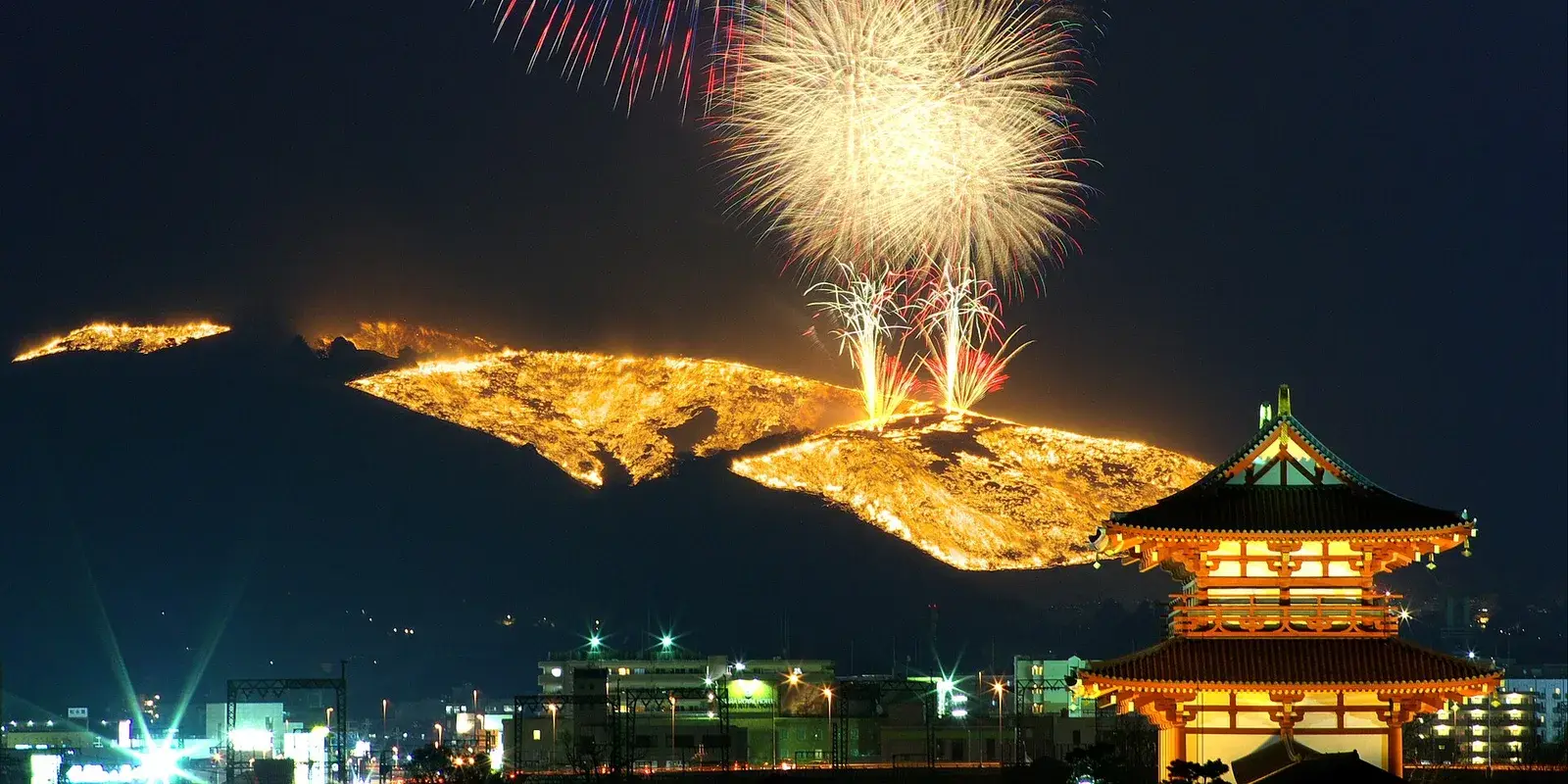
| 23 January 2027 | Wakakusa Yamayaki | Mount Wakakusa, Nara | Fireworks, then the grass on the whole hillside is set alight |
Seeing the Shirakawa-go light-up takes some planning. The village's tourist association says entry on light-up evenings is by advance reservation and entry ticket only, and that tickets are not sold on the day. It also says an evening may be called off if a severe cold wave threatens to block the roads.
At Nozawa Onsen, the fire festival is held every year on 15 January. For 2026, a notice on the Nozawa Onsen Mountain Resort Tourism Bureau's site said entry to the festival grounds was by ticket, and that tickets went to people living in the village and guests staying there, so a room in the village was the way in. Is Nozawa Onsen Worth It? has what visitors say about the village in winter.
Wakakusa Yamayaki is held on the fourth Saturday of every January. After the fireworks, members of the local fire brigade carrying torches light the grass on the hill all at once, according to the official site.
Last verified: 2026-11
January Customs, Then and Now
Customs carry on after the first days of the year. On 7 January people eat nanakusa-gayu, rice porridge with seven spring herbs. On 11 January comes kagami-biraki, when the round rice cakes offered at New Year are taken down and eaten. Around 15 January, known as koshogatsu, the "little New Year", New Year decorations are taken down and burned, according to Nippon.com.
Of the 97 posts we collected about these customs, 51 are about nanakusa-gayu, 36 about the fires where New Year decorations are burned, called dondo-yaki, tondo or sagicho in different places, 11 about kagami-biraki and 3 about koshogatsu, and four of the posts touch on two of these.
Of the 51 posts about nanakusa-gayu, 24 say the writer made it or ate it that year, or usually does, and 16 say they skipped it that year, have stopped or have never had it. Ten of the 16 tie it to their family: children growing older, family members who did not like it, or a family that never ate it. One writer, in January 2026, makes it the way her mother did.
母はいつも「七草粥」を 朝食に作ってくれていました。 My mother always made nanakusa-gayu for breakfast.
Later in the same post:
そんな私も今では母となり、 どんなに仕事の準備でバタバタしていても 家族のために朝食には「七草粥」を作ります。 Now I'm a mother too, and however rushed I am getting ready for work, I make nanakusa-gayu for my family's breakfast.
In a 2020 thread about the porridge, another writer explained in one line why it stopped at home.
父の「草喰いたくない…」で廃止になった It was abolished after my father said, "I don't want to eat grass…"
Of the 36 posts about the fires, 22 describe one still held where the writer lives, or one they went to, two of them called off that year by strong wind. Seven say the one where they live or grew up has stopped, or that they no longer see one. A writer who moved to Nagano Prefecture went to their district's fire in January 2025.
良いなと思うのは、正月飾りを玄関に出しておくと、朝のうち子ども達が回収に来てくれること。 そうやって子ども達が地域に関わる機会が今でも続いているのですね。 What I like is that if you put your New Year decorations out at the front door, the children come round in the morning to collect them. So there are still chances like this for children to be part of the neighborhood.
A woman in her forties wrote in January 2026 that the sagicho fire near her parents' home had stopped that year.
それが、今年から、なくなったそうだ。 私は、もちろん結婚し、違う土地に嫁いだ。 And from this year, I hear, it's gone. I married, of course, and moved somewhere else.
Later in the same post:
時代は変わる。今は本当に時代が大きく変わる変革期なのだと思う。 だけど、ほんとに寂しい。 Times change. I think we really are in a time of great change now. But it's so sad.
Four of the 11 posts about kagami-biraki mention rice cakes that now come in plastic packs or wrapped one by one. One writer found it easier in 2026.
お餅は1個ずつ袋に入っているので、昔みたく割ったりしないのでラクですね。 The rice cakes come in their own bags one by one, so you don't have to break them like in the old days, which is easy.
The Nozawa Onsen Dosojin Fire Festival in the table above is a koshogatsu fire festival, according to the village's tourism bureau. In the posts we collected, the neighborhood fires are held in parks, in shrine grounds and in rice fields.
Share Your Experience
Will you be in Japan this January, or have you been in January before? Tell us through Voice Box whether the places you visited were quiet, whether snow changed your plans, and whether you saw new adults on Coming of Age Day. We'll add what visitors tell us to this article.
More Japanese Perspectives
- Japan in December: December weather by city, the year-end rush and the closures before New Year, one month earlier.
- Japan at New Year: what closes from 31 December to 3 January, the shrine queues, and first sales and lucky bags.
- Surviving Japan's Winter: Japanese posts on cold living rooms, and what people wear and carry through the winter.
- Setsubun in Japan: bean throwing and ehomaki on 3 February, the next festival after January.
- Is the Sapporo Snow Festival Worth It?: what visitors and Japanese people say about the snow sculptures in early February.
- Are the Snow Monkeys Worth It?: the monkeys in the hot spring in Nagano, in the snow season.
Sources
Primary research data
WMJS January research data: 251 posts in Japanese, written between 2010 and 2026 and gathered in November 2026 from discussion threads, Q&A pages, posts on X gathered on a curation site, personal blogs and the comments under them, travel diaries, one counselor's column and an anonymous diary site.
- What people wear in January: 51 posts
- Travelling in January after the New Year holidays: 49 posts
- Coming of Age Day: 54 posts
- January customs after the first three days of the year: 97 posts
Each post's source URL is kept in this site's research data. The dates given for individual posts and threads in the article (the 2010 forum thread, the January 2025 threads, December 2023, January 2024, the January 2020 posts on X, the 2020 and 2026 threads, January 2025 and January 2026) are when they were written. The January 2024 Kyoto trip and the January 2026 Hokkaido trip are when the trips took place.
Government and official sources
- Japan Meteorological Agency: climate normals for 1991–2020, monthly values for Sapporo, Aomori, Sendai, Niigata, Kanazawa, Tokyo, Nagoya, Kyoto, Osaka, Hiroshima, Fukuoka and Naha. January averages, highs, lows, precipitation, sunshine, snowfall and days with snow, with every month's average temperature, December and February highs for Tokyo, and Tokyo's monthly sunshine and humidity for comparison.
- Japan Meteorological Agency: daily climate normals for January for Tokyo, Kyoto and Sapporo. Average highs and lows through January, and Sapporo's average snow depth on 1 and 31 January.
- National Astronomical Observatory of Japan: sunrise and sunset for January 2027 in Tokyo, Kyoto, Sapporo and Naha, and the 24 solar terms for 2027 (Shokan on 5 January and Daikan on 20 January 2027).
- Cabinet Office: About national holidays. National holidays for 2027, including New Year's Day on 1 January and Coming of Age Day on 11 January, and the meaning of Coming of Age Day (the second Monday of January).
- Act on Holidays of Administrative Organs (行政機関の休日に関する法律), Article 1: national government offices are closed from 29 December to 3 January. e-Gov
- Banking Act Enforcement Order (銀行法施行令), Article 5: bank holidays include 31 December to 3 January. e-Gov
- Japan Tourism Agency: Overnight Travel Statistics Survey, confirmed figures for January to December 2025 (Excel), Table 8, room occupancy by month and prefecture. Nationwide 54.6% in January and 61.6% for the year; Kyoto 52.8% in January and 76.8% in October; Tokyo 71.1%, Osaka 71.6%, Ishikawa 44.2% and Nara 37.6% in January.
- Imamiya Ebisu Shrine: official site. Toka Ebisu on 9, 10 and 11 January, with lucky bamboo branches.
- Japan Sumo Association: Annual tournament schedule. The January 2027 tournament at Ryogoku Kokugikan runs from 10 to 24 January 2027, with advance tickets on sale from 5 December 2026.
- Shirakawa-go Tourist Association: Outline of the 41st Shirakawa-go Light-up (2027), 1 October 2026. 11, 17, 24 and 31 January 2027, 17:30 to 19:30, by advance reservation and entry ticket only, with no tickets sold on the day, and a possible cancellation if a severe cold wave threatens to block the roads.
- Nozawa Onsen Mountain Resort Tourism Bureau: The Nozawa Onsen Dosojin Festival. A koshogatsu fire festival held on 15 January; the attack on the shrine pavilion begins at about 20:30; a notice for 2026 on the page says entry to the festival grounds was by ticket, with tickets given to village residents and guests staying in the village.
- Wakakusa Yamayaki Executive Committee: Wakakusa Yamayaki official site and Nara Prefecture's Wakakusa Yamayaki page. Held on the fourth Saturday of January every year, on 23 January in 2027; fireworks, then members of the local fire brigade with torches light the hillside all at once.
Media sources
- Nippon.com: Mutsuki: Traditional Annual Events in January, 12 January 2024. Nanakusa on 7 January, kagami-biraki on 11 January, and koshogatsu on 15 January, when New Year decorations are taken down and burned.
- Nippon.com: Seven Herbs for the New Year: "Nanakusa" Packs a Vitamin Punch, 6 January 2022. Nanakusa-gayu eaten on 7 January.
- Nippon.com: "Kagami Mochi": Japan's New Year Rice Cakes, 26 December 2024. Kagami-biraki on 11 January.
Note on Quotations
The Japanese quotes are copied from the posts as written, typos included. Most are excerpts, and many begin or end partway through a post. The two quotes in a row from the nanakusa-gayu writer, and the two from the sagicho writer, are separate passages from the same post. The … in 「草喰いたくない…」 and in 「暑くないのかな…」 is the writer's own. The English under each quote is our translation. Each original post's URL is kept in our research data.
This article is available in languages covering 95%+ of visitors to Japan (based on JNTO 2025 data). Need another language? Let us know through Voice Box.
WMJS is written in Japan, in English, with AI help. We check every page, but English is not our first language. If a sentence reads oddly, tell us. One sentence is enough.
Thank you. A person reads every note.
How well do you know Japan?
Built from 635 public posts by Japanese people
Want to know more? Ask Japanese people
Have a follow-up question about this topic? We'll ask real Japanese people.
Voice Box →