
How Japan Works
Setsubun in Japan: Bean Throwing, Demons and the Ehomaki Sushi Roll
Key Takeaways:
- In 2027, Setsubun falls on Wednesday 3 February. People throw beans to drive out demons. It isn't a national holiday
- Japan's national tourism organization says people throng temples and shrines to compete for lucky beans thrown by priests, monks or famous figures, and its calendar shows a few places that charge or limit entry, so read the notice for wherever you're going. In posts we read, people walk up and join in at Senso-ji in Tokyo, including a couple visiting from overseas in 2026
- The custom is to face north-northwest in 2027 and eat ehomaki, a thick sushi roll, whole and in silence. Japan's agriculture ministry adds that a thick roll is hard to finish in one go, so don't force it
- Of 46 public posts by Japanese people about going to bean throwing at temples and shrines, 15 describe a good time and 6 describe not enjoying it. In 21 of the 46, the writers mention pushing, scrambling or danger, including some who still enjoyed it. Seven of the 46 mention foreign people at or near the event, too few to say how Japanese people feel about visitors joining in, and none says they shouldn't be there
- Japan's Consumer Affairs Agency asks parents to hold off on hard beans and nuts until a child is 6, because of the risk of choking
What is Setsubun in Japan? It's the day before the traditional start of spring, 3 February in 2027. People throw roasted soybeans while calling out "demons out, fortune in", and a custom of eating ehomaki, a thick sushi roll, while facing the year's lucky direction has spread across the country. You can join the crowd at temples and shrines. As for the roll, you can take it easy: Japan's agriculture ministry says not to force it, and of 87 public posts by Japanese people about it, 9 describe slicing it or serving it cut.
Quick Guide
| On Setsubun | What to know | |
|---|---|---|
| 🟢 Bean throwing | Stand in the crowd at a temple or shrine | Bring a bag or hold out a hat. Senso-ji and Zojoji in Tokyo both held theirs on 3 February in 2026. Posts from Zojoji and Todai-ji describe queues. |
| 🟢 Ehomaki | Buy one at a supermarket or convenience store | Face north-northwest in 2027. Your phone's compass will find it. |
| 🟡 Crowds | It can get rough near the stage | If you'd rather keep out of the pushing, stand further back and watch. One person at Senso-ji in 2026 heard police say strollers weren't allowed in. |
| 🟡 Small children | Hold off on hard beans and nuts until age 6 | The Consumer Affairs Agency asks this because of choking. |
| 🟡 Dates and times | Look again in January | Most notices we could read are from 2026. |
🟢 is simple to try. 🟡 is worth a moment's thought first.
What Setsubun Is
Setsubun (節分) means "dividing the seasons". There's one before the traditional start of each season, and the word now usually means the one before spring. The date isn't fixed: 2 February in 2025, 3 February in 2027. It isn't a national holiday, so in 2027 it's an ordinary Wednesday.
The call you're most likely to hear is oni wa soto, fuku wa uchi (鬼は外、福は内), "demons out, fortune in". According to the agriculture ministry, demons were thought to come at the change of season and bring disaster and disease, and throwing beans drives them out so that good fortune can come in. Afterwards you eat as many beans as your age, or one more, which is said to keep you well. Young children are the exception: the Consumer Affairs Agency asks that they aren't given hard beans, because of the risk of choking.
Driving out demons is older than throwing beans. The National Diet Library traces a ritual called tsuina, held on the last night of the year to drive out disease, back to at least 706, and cites a diary from 1447 that describes beans scattered in every room at dusk while calling out the same words. The library says tsuina and Setsubun were separate events that had fully merged by the Edo period (1603 to 1868). It gives several explanations for the soybeans, one of them a play on words: mame, "bean", can be written with characters meaning "destroy evil".
How We Gathered These Voices
The voices here are 419 Japanese-language posts on six topics, from 176 threads, articles and pages on Q&A sites, message boards, blogs and social media. 399 of the posts have a date, from 2006 to 2026, and 177 of those are from 2019 or earlier. None of them was written for us, and we didn't question anyone. Seventeen of the posts come from a sweets maker's web page of readers' Setsubun memories, which the company compiled. We looked both for people who keep these customs and for people who don't, so these counts can't show how common anything is in Japan. Each set of three bars covers one topic's posts. Some sort posts by what the writers do, such as whether they throw beans at home. The others sort them by how the writers feel. In those, a post that only describes what happened counts as neutral.
Catching Beans at a Temple or Shrine
At these events, people on a stage throw lucky beans into the crowd. The Japan National Tourism Organization's calendar says people throng temples and shrines to compete for them. In the posts we read, the beans come in small bags, sometimes with sweets or mochi, and people hold out a bag or a hat, or a backpack. You don't need to say anything to hold out a bag. One writer at Senso-ji in 2026 heard police announcing in Japanese not to push, crouch or pick up fallen beans, so it helps to know that before you go. Some writers walk straight into the crowd. Others queue and go in by groups: one writer at Zojoji in 2024 waited about 20 minutes, and a 2026 post describes the same system there.
You may wonder whether you'd be in the way. That tourism organization's calendar is in English, comes from its Tourist Information Center, and gives times for Senso-ji, Zojoji and Naritasan, so these are events it points visitors to. Foreign people come up in seven of the 46 posts we gathered about going to these events, partly because some of our searches looked for such posts. That's too few to say how Japanese people feel about it, and none of the seven says they shouldn't be there. Four only mention that foreign people were there, or how many. The writer at Senso-ji in 2026 who heard the police is critical of someone with a child and a stroller. Police had said strollers weren't allowed, and the writer thought this person understood, but the person began to step out, went straight back to the same spot, and left only when an officer came in and told the person to go. Here are the other two. In another post, from Asakusa in 2025, someone in the crowd who seemed to be from abroad used a phone translator to ask the writer what was about to start and what to do with the beans. The writer could only manage "bean throwing", "a seasonal event" and "you eat them", and wished afterwards for a better answer:
日本の伝統行事なのに的確に説明することができなかったのが残念だった。 It's a Japanese tradition, and it was a shame I couldn't explain it properly.
A Japanese language teacher was at Senso-ji with a couple visiting from overseas when it happened to start, so they joined in:
無事にみんなゲット! 貴重な思い出が出来ました! We all caught some! It made a precious memory.
This table gives seven places with bean throwing and one with lanterns. Times marked JNTO come from the Japan National Tourism Organization's February 2026 calendar, and the rest from each place's own page. We read these in early November 2026, before most 2027 notices were out. The pages are in Japanese, so you may want to run them through a translator, and searching the place's name with 節分 should bring up the newest.
| Place | What happens | Year of notice |
|---|---|---|
| Senso-ji, Tokyo | 3 February. JNTO lists bean throwing at 11:30 and 13:30 by people who applied in advance, and at 16:00, 16:20, 16:40 and 17:00 by well-known guests. | 2026 |
| Zojoji, Tokyo | 3 February. JNTO lists bean throwing at 12:20. Sumo wrestlers and entertainers throw. The public can apply to throw too, so look for the 2027 notice. The page we read doesn't say what it costs to throw. Posts from 2024 and 2026 describe people queuing and going in by turns. | 2026 |
| Naritasan, Narita | 3 February. JNTO lists bean throwing at 11:00, 13:30 and 16:00. The people on the stage in 2026 included sumo wrestlers and actors from a TV drama. It's a 10-minute walk from Narita Station, on the JR line to Narita Airport. | 2026 |
| Yasaka Shrine, Kyoto | 2 and 3 February. Geiko and maiko, Kyoto's traditional entertainers, dance at 13:00 and 15:00 on both days, with bean throwing after each. There are other rounds too, listed on its page. Lucky beans cost ¥300 and come with a raffle ticket. Beans thrown from the stage don't come with a ticket. | No year given |
| Kitano Tenmangu, Kyoto | 3 February. At 13:00, a kyogen comedy in which a god of fortune drives out a demon, then dances by geiko and maiko, then bean throwing. | 2026 |
| Heian Jingu, Kyoto | A demon dance and bean throwing at 15:00, followed by a great fire ritual. The notice gives no date. | 2026 |
| Kasuga Taisha, Nara | 3 February. A lantern event, and the notice doesn't mention bean throwing. About 3,000 lanterns are lit by about 18:00, and the gates are due to close at 20:30. The inner corridor costs ¥700. A guided visit on 3 February 2027 starts at 19:30 and costs ¥3,000. It runs if at least five people book, through the agencies on its page. | Every year, and 2027 |
| Osu Kannon, Nagoya | 3 February, 10:00 to 18:00. A ticket to throw from the stage cost ¥3,500 on the day. A procession set off from Hisaya Odori Park at 13:18 and walked to the temple. | 2026 |
None of the seven bean-throwing pages in this table mentions a charge for standing in the crowd. JNTO's 2026 calendar does list ¥400 admission at Hase-dera in Kamakura and numbered tickets for picking up beans at Tsurugaoka Hachimangu, so read the notice for wherever you're going.
Two more, if you're in Sapporo or Kyoto. Hokkaido Jingu held its 2025 bean throwing outdoors and warned that weather could cancel it. Yoshida Shrine runs its festival over three days around Setsubun, with a demon-chasing ritual the day before and about 800 stalls on the day before and the day itself. Its page doesn't mention bean throwing, though it offers lucky beans that come with a raffle ticket.

The throwing itself can be short, so if you arrive late you may miss it. One writer at Senso-ji in 2023 arrived five minutes before noon, reached the middle of the crowd, and saw it start at about 12:10 and go on for about five minutes. The writer who heard the police there in 2026 says it began at about 12:15, while JNTO's calendar for that year lists 11:30, so stay on if nothing has started. A writer at Yasaka Shrine in 2025 saw people gathering an hour ahead, came back 10 minutes before the start, got nearer the front than expected and still caught nothing. At Todai-ji in Nara in 2025, a writer who had heard numbers would be limited came 90 minutes early and found about 200 people queuing. Where entry is limited, as with Tsurugaoka Hachimangu's numbered tickets, arriving late can mean not getting in, so go by the notice.
Some writers simply love it. This one went to a local shrine in 2024:
家族揃って楽しめる節分の雰囲気が大好き!豆まきってテンションが上がりますよね(^-^)豆まきの結果は…1袋(笑) I love the Setsubun atmosphere that a whole family can enjoy! Bean throwing really gets you going. The result of my bean throwing... one bag, lol.
Other people in the crowd can be kind. A parent holding a baby, with a 4-year-old alongside, wrote:
息子はまだキャッチする能力は低いし、私は0歳児を抱っこしてたので一つも豆をキャッチできませんでしたが、隣にいたおじいちゃんが何度も取った豆を息子に渡してくれて、合計14袋ゲットしました。(9割おじいちゃんからもらった) My son isn't good at catching yet and I was holding my baby, so I didn't catch a single bean, but the older man next to us kept handing my son what he caught, and we ended up with 14 bags. (Nine-tenths of them from him.)
💡 If you catch more than you need
Look around for a family that hasn't caught anything. One writer, leaving a shrine in Chiba, shared two bags with a parent and child who had none, and wrote that it was a happy moment.
It can also get rough. Someone who went along to a local shrine on 3 February, on a day off, describes about 100 people politely making room for each other beforehand, and then this once the throwing began:
…もう小さな戦場みたいになっておりました。 It had turned into a small battlefield.
The writer stepped on someone's hand by accident and may not go again. Someone who toured three places in Nikko in 2026 compared the first to a mosh pit, and still called the tour fun:
参加すると、久しぶりにライブのモッシュを思い出したくらいに激しかった。 Once I joined in, it was so wild that it reminded me of the mosh pit at a live show, which I hadn't thought of in ages.
One writer held a backpack open and found, among the beans, a 5-yen coin from the year the writer was born. The same post has a warning:
思いの外、豆が顔に当たると痛い。 It hurts more than you'd expect when a bean hits you in the face.
One writer at Zojoji stooped for fallen bags and, in that tight a crowd, couldn't stand up again:
地面に落ちたのを拾うのは踏まれたりして危険なので、やめたほうがいいですね(汗) Picking up what's fallen on the ground is dangerous, because you can get stepped on, so better not to.
Where you stand changes what reaches you. One writer far from the stage at Senso-ji in 2024 caught two and enjoyed them at home, and two others saw beans fall only a metre or two from the stage. Being right at the front is no promise either. The writer who queued at Zojoji in 2024 had caught some beans about a minute after arriving, while watching from the side. Once inside, standing so close to the stage, the writer caught no beans or sweets there, only tissues.
If You Have Small Children With You
Think first about the pushing near the stage. The 2026 Senso-ji post mentioned above also describes police using cones to mark off a block for small children and elderly people, and announcing that strollers couldn't come in. If you have a stroller, plan to watch from outside the crowd. The writer who toured Nikko found children's areas at two of the three places, so look around for one when you arrive. Demons appear on stage at some events, such as Heian Jingu and Kitano Tenmangu in the table, and a mask can frighten a small child. One parent's 14-month-old cried at a mask from a supermarket.
If a child of 5 or under ends up with a bag, the beans inside are for the adults. The Consumer Affairs Agency warns that hard beans and nuts can cause choking or go down the windpipe in children whose back teeth haven't all come in and who can't yet chew and swallow them well. It asks that children aged 5 and under aren't given them, suggests individually wrapped beans for throwing, and asks that beans are cleared away so young children can't pick them up. It also warns about round, slippery foods and sticky ones, so check any sweets and mochi before a small child gets them, and it says to take the same care with food when eating out and at local events.
For how to behave at a temple or shrine in general, see visiting temples and shrines.
Ehomaki, the Sushi Roll
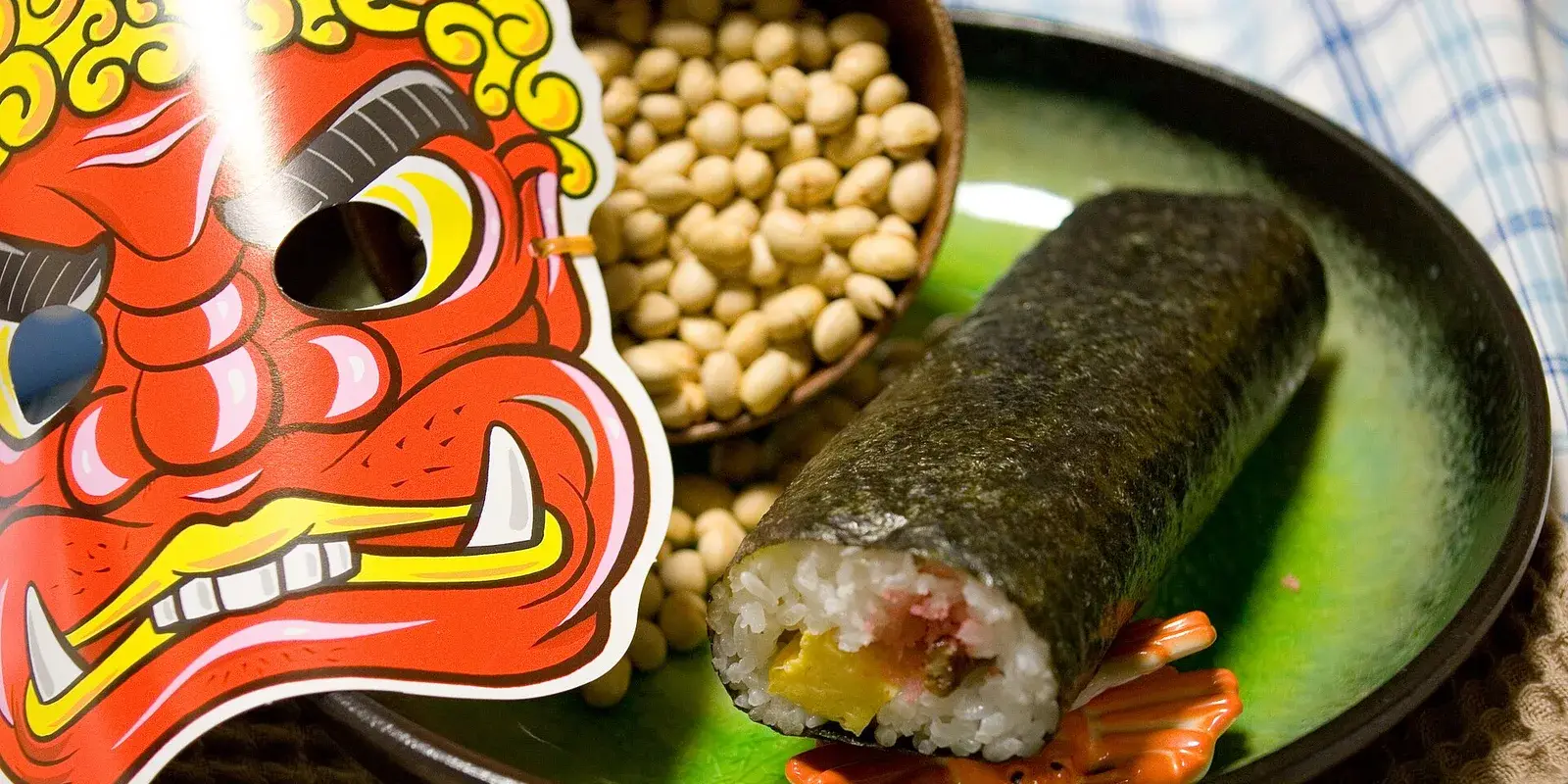
Ehomaki (恵方巻) is a thick sushi roll, and supermarkets and convenience stores across Japan sell it around Setsubun. One writer's supermarket had half sizes too, and the writer bought tuna mayo, beef and salmon rolls, among others. If you leave it late on the day, you may have to try more than one shop: someone who reached the shops at about 19:30 in 2026 found little left at three supermarkets, and got a salad roll at a convenience store.
The agriculture ministry describes the custom like this: face the year's lucky direction, think of a wish, and eat the whole roll without speaking, because talking lets the luck out and cutting the roll is said to be unlucky. It adds that eating a thick roll in one go is hard, so don't force it and eat it in whatever way is easy, and that a bigger roll brings no more luck, so choose one you can finish. If you're with young children, the Consumer Affairs Agency suggests cutting the roll small and having a drink ready, and warns against laughing or running with food in the mouth.
The direction changes each year. This table sorts the ministry's list by the last digit of the year, and you can find the direction with your phone's compass:
| Year ends in | Face |
|---|---|
| 7 or 2 | North-northwest (2027) |
| 6, 1, 3 or 8 | South-southeast |
| 4 or 9 | East-northeast |
| 5 or 0 | West-southwest |
A public library's answer in the National Diet Library's reference database cites a study placing rolls like this in a small part of Osaka by the Taisho era (1912 to 1926) or the years before the Second World War, under other names. It also cites Seven-Eleven's own account of first selling one in Hiroshima in 1989, drawing on a Kansai custom, and says the name seems to have caught on after the chain used it in 1998. The ministry's page on Osaka food says the origin is uncertain. It's said to come from Osaka. Theories point to a game played in the entertainment districts and to merchant houses at the end of the Edo period. The nori seaweed trade promoted it from about the 1970s, and it spread nationwide after convenience stores and supermarkets began selling it in the 1990s. Some shops now take orders in advance, the page adds, after concern over food waste, and the ministry has asked food retailers since January 2019 to match what they sell to demand.
In 17 of the 87 posts, people eat it in silence or have tried to. In one family, the silence lasted three seconds:
3秒後。 子どもが吹き出す🤣 私もつられて笑う🤣🤣 はい、無言終了〜。 Three seconds later, my child burst out laughing. I laughed too. And that was the end of the silence.
The same writer adds:
黙って食べられなくてもOK。 方角ちょっとズレてもOK。 It's fine if you can't stay silent. It's fine if the direction's a little off.
A family in Kyoto made a game of it:
無言で1本食い切らないとご利益無効、と親に言われるので兄弟でお互いに声を出さそうと笑かせあいながら食べておりました My parents said the luck wouldn't count unless you finished the roll in silence, so my siblings and I ate it while trying to make each other laugh.
Someone else got the rule wrong on the first try:
初めて食べた時、「しゃべらないで食べる」を「息をしないで食べる」と勘違いしてて死にそうになりました。涙。 The first time I ate it, I mistook "eat without talking" for "eat without breathing" and nearly died. I was in tears.
Another writer kept it up for years:
10年くらい、まじめに黙々と恵方を向いて食するのが習慣でしたが、まったく願いが叶わない笑 For about 10 years my habit was to eat it earnestly and silently, facing the lucky direction, but my wishes haven't come true at all, lol.
That writer now eats a half size, often ends up talking, and says nothing bad has come of it. Doing this at work is harder to explain. One office worker, alone at lunch, was facing the direction when the boss came back:
コンビニの安い恵方巻きを買って、ランチに事務所でもしゃもしゃ食べました みんな客先に出てるから、方角に向かって食べてたら上司が戻ってきてヤバイものを見た目をして黙ってデスクに座って仕事を始めた I bought a cheap ehomaki at a convenience store and munched it at the office over lunch. Everyone was out at clients, so I was eating it facing the direction when my boss came back, gave me a look as if seeing something alarming, sat down at the desk without a word and started work.
In nine of the 87 posts, people slice it or serve it cut, and one from Osaka says biting into a whole one ruins the roll. In nine, the writers complain about the price or give it as the reason they don't buy one. Someone who has lived in Tokyo for about 65 years has no habit of eating it, but finds one use for it:
でも、この日はスーパーで、いろんな恵方巻きを売ってるので、 それを買ってきて、夕飯を手抜きする。 But on this day the supermarket sells all kinds of ehomaki, so I buy them and take it easy with dinner.
Writers in or from the Kansai region don't all remember it the same way. Of the 87 posts, 9 are by Kansai writers whose families didn't do it, or who say there was no such thing when they were children, and 17 are by Kansai writers who were eating it as children or by the 1990s.
当方生まれて以来ずっと関西住まいですが、恵方巻きなるものの存在を知ったのは2000年頃にコンビニやスーパーが売り出すようになってからです。 I've lived in Kansai all my life, and I only learned such a thing as ehomaki existed around 2000, when convenience stores and supermarkets began selling it.
大阪ですが、我が家では70年代後半には節分に一定の方角を向いて切ってない太巻き寿司を食べていました。 I'm in Osaka, and by the late 1970s my family was eating uncut thick rolls on Setsubun, facing a set direction.
If you lose track of north-northwest, slice the roll or start talking, you're doing what people in these posts do. You'll most likely be eating it at your hotel anyway.
Throwing Beans at Home
You'll probably only see this if you're staying with friends or family in Japan. If you're given beans, throw them, and expect some picking up afterwards.
Cleaning up or picking up the beans comes up in 28 of the 58.
します。 転がります。 5月頃に発見されたりする場合もあります。 I do. They roll. Sometimes they turn up around May.
In eight of the 58 posts, people throw, or used to throw, beans that are wrapped or still in the bag.
共用廊下に豆をばらまくわけにはいかないので、小袋に入った福豆を投げてささっと拾っています。 I can't scatter beans in the shared corridor, so I throw lucky beans in small bags and quickly pick them up.
Some stop when the children grow up:
やってたけど、子供ももう成人したし今年はやめるつもり。 I used to do it, but my kids are adults now, so I plan to stop this year.
Others do it with no children around at all:
上京したてでぼっちだけど、インコが大豆好きだからやるよ。 … ちょっと寂しい、お母さんに会いたい。 I've only just moved to Tokyo and I'm on my own, but my parakeet loves soybeans, so I'm doing it. … It's a little lonely. I want to see my mum.
Demons at Nursery School and at Home
Today, the agriculture ministry says, someone plays the demon while the family throws beans. In more than half of the 78 posts on this topic, the demon turns up at a nursery school or kindergarten, so you may never meet this one as a visitor.
In one childhood memory, Dad comes in through the balcony window in a mask with a roar, and the children shriek and throw beans at him:
パパ鬼はいつも喜劇役者なみに倒れ込む。笑 Papa demon always collapsed like a comic actor, lol.
In another home, the father was the demon until someone called "Papa!" and he answered, so the secret was out. The child still enjoyed it and threw a huge number of beans at him, even with no mask on. Some memories are heavier:
幼稚園の時節分で鬼が怖すぎて泣きまくって、鬼からミルクいちご飴貰ったけど、大人になった今でもミルクいちごを見ると恐くてたまらない。 At kindergarten on Setsubun the demon scared me so much I cried and cried. It gave me a strawberry milk candy, and even as an adult, the sight of strawberry milk candy terrifies me.
Parents differ on how frightening a demon should be. At one nursery school with a very frightening demon, someone asked whether it was needed, and one parent wrote:
「喜怒哀楽と同じで恐怖も大切な感情。怖いことがあった後の心の回復を小さいころから体験するのが重要」と聞いて納得したの。 I heard, "Like joy, anger and sadness, fear is an important feeling. It matters to experience recovering from something scary from a young age," and that convinced me.
Another parent writes that the nursery told parents it would take more care over the demon after parents commented. That parent's son came home saying the demon had been brought in on a rope, with the head of the nursery holding it. One parent, who thinks the idea came from kindergarten, wrote:
5歳の子供が自分の弱虫鬼を退治するんだって言ってた で、お母さんはおこりんぼ鬼を退治してねってお願いされた My 5-year-old said, "I'm going to defeat my scaredy-cat demon," and then asked me to defeat my grumpy demon.
Peanuts, Bean Counts and Chants
Soybeans aren't the only choice. If you're staying with a family in Hokkaido, Tohoku or Niigata, you may be handed peanuts, according to a 2001 study. From the Tokai region westward it's mostly soybeans, and in Nagano some homes use soybeans and some peanuts. A trade group quoted there also names Miyazaki as a peanut area. In Hokkaido, homes started throwing peanuts in the decade after 1945, and many more did over the next 20 years. Among the reasons given are that the nuts stay clean in the shell and are easy to pick up.
From someone who grew up in Tohoku:
関東にきたらかわいい豆で、これで鬼は退治できないよ!と思いました When I came to Kanto the beans were so cute that I thought, you can't defeat a demon with these!
With peanuts, counting one for each year of your age gets complicated:
歳の数だけ食べるという事が殻ごとの数なのか、中の身の数なのかいつも迷いました。 I always wondered whether eating your age meant counting the shells or the nuts inside.
For some, it gets harder over the years:
子供の頃、年の数しかお豆を食べられなかったのが物足りず大人がうらやましかったのに、年を重ねるにつれ年の数だけお豆を食べるのが苦しくなった・・・ As a child, only getting my age in beans wasn't enough and I envied the adults, but as I've got older, eating my age has become a struggle...
In one family, a great-grandmother with 80 beans to get through often handed some to the children.
At Senso-ji, nobody calls "demons out" because, the temple says, no demons stand before Kannon, the deity it enshrines. The call there is 千秋万歳福は内, roughly "long life, and fortune in", which ends in the same fuku wa uchi. At Osu Kannon the call is "fortune in, fortune in", and the temple leaves out "demons out" because of a demon mask among its treasures. Kinpusen-ji in Yoshino calls "fortune in, demons in too". In one home, the grandfather adds 鬼の目ん玉ぶっつぶせ, "smash the demon's eyeballs". One husband writes about a different version:
少なくとも我が家では、 「夫は外、妻子は内」 という掛け声で私が豆を被弾しまくってますね。 In our house, at least, with the call "husband out, wife and kids in", I take hit after hit from the beans.
If you're given peanuts, you can throw them in the shell.
Setsubun Then and Now
Most of the 53 posts on this topic compare Setsubun now with how it was.
半世紀前、私が小学生くらいの頃は、都内でも あちこちから「鬼は外、福は内」の声が心地よく響いたものです Half a century ago, when I was about primary school age, voices calling "demons out, fortune in" rang pleasantly from all around, even in Tokyo.
In five of the 53 posts, people say they hear these calls less, or that they keep, or kept, their own voices down.
昨今は豆などまくと苦情が来そうで怖いから。 「おにはーそと」と大声出したらまた苦情。 こっそりまく豆のなんと切ないことか These days I'm scared of complaints if I throw beans. Shout "demons out" and that's another complaint. How forlorn it is to throw beans on the sly.
One person kept going through high school after friends had stopped, saying the words in a whisper. Others carry on. In 2017, someone wrote:
20歳です。毎年家族全員でやります。 I'm 20. My whole family does it every year.
Another writer, who stopped on starting work, wonders whether it will come back:
自分も結婚して子どもが生まれたら、また豆まきをやる日が来るのかなと思うと、なんだかちょっとワクワクもしますね☆ When I think the day might come when I throw beans again, if I marry and have children, I even feel a little excited.
Some writers also describe putting a sardine head outside the door, something an old survey of local customs asked about, according to the National Diet Library:
子供の頃から親が毎年必ずやっていたので、当たり前の様に鰯を焼いて頭を割り箸などに刺し玄関外に....一人暮らしを始めた20歳の時にやったら近所の人に凄く笑われた(泣)笑われても毎年やります。 My parents did it every year when I was a child, so as a matter of course I'd grill a sardine, stick the head on a disposable chopstick or the like, and put it outside the front door... When I did it at 20, having just started living alone, the neighbours laughed at me a lot (sob). Laugh if they like, I do it every year.
If You're in Japan on 3 February
If you go to a temple, take a bag and wear something warm. For the cold, see surviving Japan's winter. You don't have to call anything, but if you'd like to, listen first, because at Senso-ji you won't hear "demons out". Away from a temple, you may only notice Setsubun at the supermarket. You can still join in: buy a roll, find north-northwest on your phone and eat it at your hotel, talking or not.
More Japanese Perspectives
- Is the Sapporo Snow Festival Worth It?: the same week in the north.
- Plum Blossoms in Japan: what starts to open around this time.
- Tanabata: another seasonal custom, and what people make of it now.
Share Your Experience
Have you caught beans at a temple, or tried to finish a whole roll without saying a word? Tell us how it went.
Sources
Primary Research Data
WMJS Setsubun research data, 419 Japanese-language posts collected in November 2026 from 176 threads, articles and pages. We recorded 483 entries and set 64 aside: 27 were a post already counted, or the same writer again within a topic, 15 weren't first-hand accounts or were off the topic, 4 were about throwing events we couldn't confirm were for Setsubun, and 18 were answers to a market research company's prompt, picked by us from about 775.
- Throwing beans at home: 58 posts
- Eating ehomaki: 87 posts
- Going to a temple or shrine event: 46 posts
- Demons and children: 78 posts
- Peanuts, bean counts and chants: 97 posts
- How people say Setsubun has changed: 53 posts
Factual Sources (Tier 1–2)
- National Astronomical Observatory of Japan, 2025 and 2027 almanac summaries: Setsubun on 2 February 2025 and 3 February 2027: https://eco.mtk.nao.ac.jp/koyomi/yoko/2025/rekiyou252.html and https://eco.mtk.nao.ac.jp/koyomi/yoko/2027/rekiyou272.html
- Cabinet Office: Japan's national holidays: https://www8.cao.go.jp/chosei/shukujitsu/gaiyou.html
- Ministry of Agriculture, Forestry and Fisheries, "Setsubun and ehomaki recipes": meaning of Setsubun; why beans are thrown; age or age plus one; how ehomaki is eaten; not to force it; the directions by the calendar's ten stems: https://www.maff.go.jp/j/keikaku/syokubunka/culture/wagohan/articles/2301/spe13_04.html
- Ministry of Agriculture, Forestry and Fisheries, "Our regional cuisines", Osaka: origin uncertain; theories; nori trade from the 1970s; convenience stores and supermarkets from the 1990s; advance orders: https://www.maff.go.jp/j/keikaku/syokubunka/k_ryouri/search_menu/menu/39_13_osaka.html
- Ministry of Agriculture, Forestry and Fisheries, seasonal food waste: requests to retailers from 11 January 2019: https://www.maff.go.jp/j/shokusan/recycle/syoku_loss/kisetsusyokuhin.html
- National Diet Library, "Book Kaleidoscope: Soybeans": tsuina by 706; the 1447 diary entry; the Edo-period merger; explanations for soybeans; the old survey asking about sardine heads: https://www.ndl.go.jp/kaleido/entry/21/1.html
- National Diet Library, "Sexagenary cycle": 丁未 in the 60-year cycle, from which we work out that 2027 is a 丁 year: https://www.ndl.go.jp/koyomi/chapter3/s1.html
- National Diet Library Collaborative Reference Database, answer by Chiba City Central Library: the roll in a small part of Osaka before the war, under other names, and the name in 1998, from an article in the journal Hikaku Minzoku Kenkyu (2009); Seven-Eleven's own account of Hiroshima in 1989: https://crd.ndl.go.jp/reference/detail?page=ref_view&id=1000188313
- National Diet Library Collaborative Reference Database, answer by Chiba Prefectural Central Library: where peanuts and soybeans are used, Hokkaido's timing and the reasons, from Takao Ikeda's 2001 paper in the bulletin of the Historical Museum of Hokkaido: https://crd.ndl.go.jp/reference/entry/index.php?id=1000128916&page=ref_view
- Consumer Affairs Agency (24 January 2023): choking risk; hard beans and nuts and children aged 5 and under; individually wrapped beans; round and sticky foods; cutting ehomaki small; the same care when eating out and at events: https://www.caa.go.jp/policies/policy/consumer_safety/child/project_001/mail/20230124/
- Japan National Tourism Organization, February 2026 events calendar: people throng temples and shrines for the lucky beans; times at Senso-ji, Zojoji and Naritasan; access to Naritasan; ¥400 admission at Hase-dera; numbered tickets at Tsurugaoka Hachimangu: https://asset.japan.travel/image/upload/v1770304514/pdf/2026_TIC/202602/Calendar-Events-Feb.2026.pdf
Official Temple and Shrine Pages
These are cited for each place's own arrangements and for what each place says about its own event.
- Senso-ji: the call; no "demons out": https://www.senso-ji.jp/annual_event/05.html
- Zojoji: who throws; public applications: https://www.zojoji.or.jp/event/ev_setsubun.html
- Naritasan: the 2026 report; sumo wrestlers and TV drama actors: https://www.naritasan.or.jp/2026/02/03/10573/
- Yasaka Shrine: dates and times; lucky beans at ¥300: https://www.yasaka-jinja.or.jp/event/setsubun/
- Kitano Tenmangu: 2026 programme: https://kitanotenmangu.or.jp/news/%E4%BB%A4%E5%92%8C%EF%BC%97%E5%B9%B42%E6%9C%882%E6%97%A5%E5%9C%9F%E7%AF%80%E5%88%86%E7%A5%AD-%E5%8C%97%E9%87%8E%E8%BF%BD%E5%84%BA%E5%BC%8F/
- Heian Jingu: 2026 programme: https://www.heianjingu.or.jp/news_list/1330/
- Kasuga Taisha: about 3,000 lanterns; ¥700 for the inner corridor; the 2027 guided visit at ¥3,000: https://www.kasugataisha.or.jp/calendar/winter02/ and https://www.kasugataisha.or.jp/events/2026/16853/
- Osu Kannon: 2026 tickets at ¥3,500 on the day; "fortune in, fortune in", without "demons out": https://www.osu-kannon.jp/gyouji/2026setsubun.html and https://www.osu-kannon.jp/gyouji/
- Kinpusen-ji: "fortune in, demons in too": https://www.kinpusen.or.jp/event/3dai.html
- Hokkaido Jingu: 2025 notice: http://www.hokkaidojingu.or.jp/news/pdf/R070124_setubun.jpg
- Yoshida Shrine: the festival, its stalls and lucky beans: https://www.yoshidajinja.com/setubunsai.htm
Last verified: 2026-11
Where the Voices Come From
Japanese Q&A sites, message boards, blogs, social media and a sweets maker's web page of readers' memories. We don't use them as factual authorities. They are first-hand accounts of these customs, and what happened at a particular event is what one writer reports.
Note on Quotations
Quotes from online platforms have been lightly edited for readability, fixing typos and formatting for clarity. Each quotation is part of a longer post or the whole of a short one, and "…" marks a gap. The meaning is unchanged.
WMJS is written in Japan, in English, with AI help. We check every page, but English is not our first language. If a sentence reads oddly, tell us. One sentence is enough.
Thank you. A person reads every note.
How well do you know Japan?
Built from 635 public posts by Japanese people
Want to know more? Ask Japanese people
Have a follow-up question about this topic? We'll ask real Japanese people.
Voice Box →