
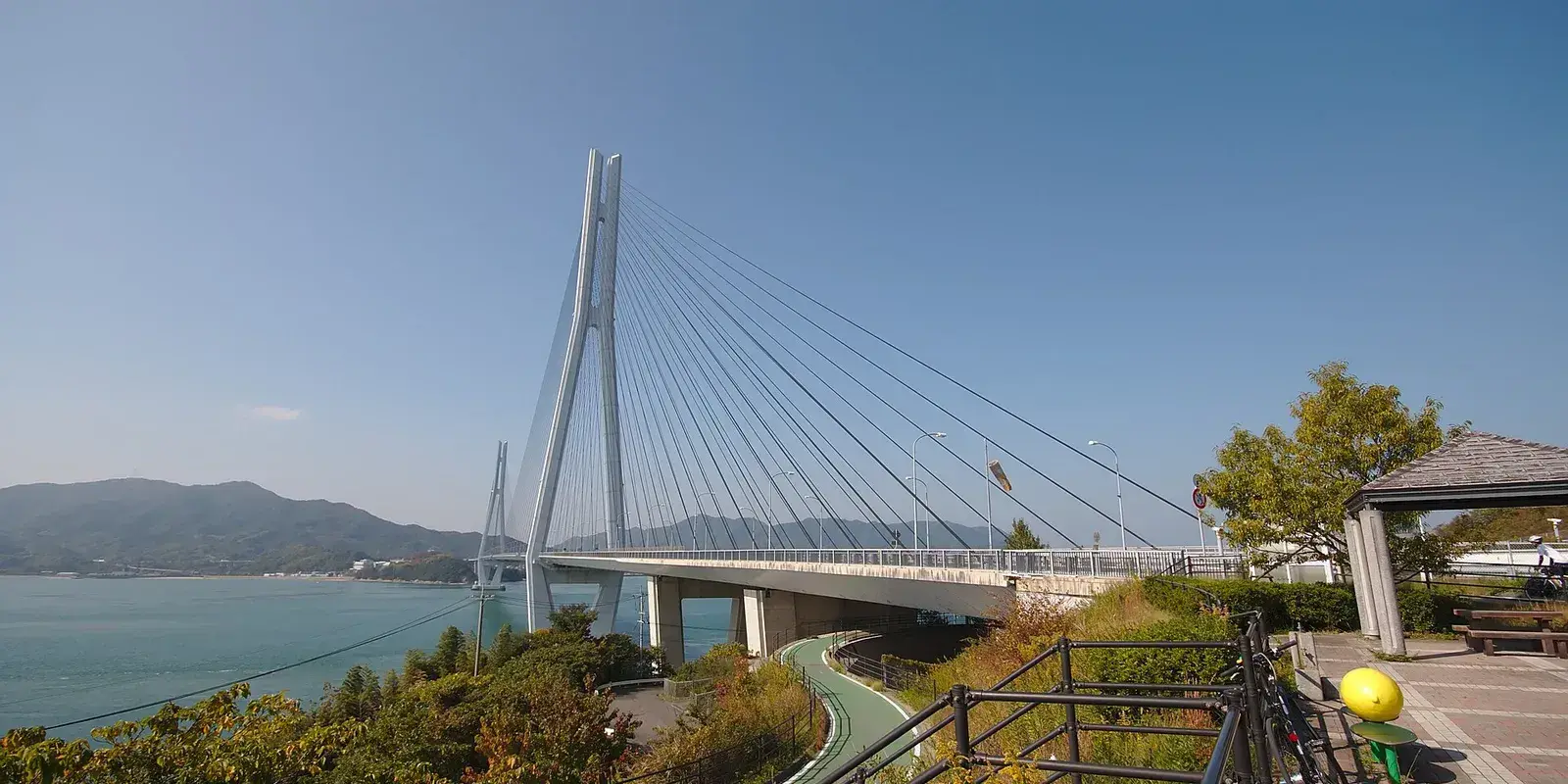
How Japan Works
Is the Shimanami Kaido Worth It? What Riders From Abroad and Visitors From Japan Say
The Shimanami Kaido links Onomichi in Hiroshima Prefecture with Imabari in Ehime Prefecture across the islands of the Seto Inland Sea. It's an expressway for cars, with a cycling route of about 70 km that crosses its bridges and runs along island roads between them. People planning a trip through western Japan may be deciding whether to set aside a day or two for it. We gathered 339 reviews and posts from people writing about their own trip. Of the 137 voices from abroad, 113 (82%) were glad they went. Of the 202 voices from Japan, 185 (92%) were glad they went.
The two groups didn't travel it in the same way. At least 114 of the 137 voices from abroad say they rode a bicycle, while about one in five from Japan say they drove. The mixed and let-down voices from abroad write mainly about the climbs, a sore body, the weather and the stretches of road between the bridges. You don't have to ride all of it. Shimanami Japan, which runs a rental service along the route, says a beginner would need more than 10 hours for the full 70 km, which it measures from Onomichi Station to the Itoyama terminal in Imabari, and lists shorter courses starting at about 9 km. Its rate for an adult's bicycle is 3,000 yen a day. Bicycles cross the bridges free of charge until March 31, 2028.
Is it worth the trip? (in visitors' own words)
We read posts and reviews by people from abroad and sorted them by how the writer felt afterward. Of the 137 voices, 58 are Reddit posts and comments, 49 are posts and replies on a Taiwanese forum, 11 are TripAdvisor reviews, 10 are YouTube comments, 6 are Google Maps reviews and 3 are replies on a travel forum.
Some glad riders write about it in the strongest terms. One who took two days called it "the best experience I've ever had in Japan". Another expected less and wrote "I thought it would be overrated, and exaggerated by the internet: IT is not". A rider on the Taiwanese forum who went in April 2024 called it "喜歡騎腳踏車的人的恩賜" (a gift to people who love cycling).
Some riders were worn out or sore and still glad. "it was still absolutely miserable and yet it’s one of my favorite memories of my trip to Japan", one wrote. Another rider wrote "My bum was aching in the end but was totally worth it!" Not every glad rider found it hard. One who wrote that it's easy to do in a day, and who had heard it hyped as a once-in-a-lifetime event, wrote "it is a very nice ride and I would definitely do it again. Nothing more, nothing less."
Twenty of the 137 voices are mixed, and 18 of them write about effort, a sore body or the weather. One rider in "relatively decent shape", whose bike was slightly too small, wrote "Those pre-bridge hilly on-ramps killed me!" Another, who did the full route, called the inclines "brutal" and said the worst part was the seat. A third called the seat a "torture device".
Not everyone found the ramps hard. A glad rider who has done it several times wrote "The slopes to the bridges are easy." A rider on the Taiwanese forum, on a long cycling tour across Japan, put most of them at about 3%.
Others write about the weather. A rider who finished the route in heavy rain wrote "The rain sucked (my feet were drenched all the time) but the road is totally doable for non hardcore bikers." Another gave up halfway when a monsoon came in and hopes to go back. A rider on the Taiwanese forum who went at the end of February wrote "2月底的氣溫不宜" (the temperature at the end of February isn't suitable).
The other two mixed voices write about something else. One rider found traffic on the last two islands heavy and wrote "I wouldn’t want to do the main road with kids." Another, who had toured Japan for two months and rode one short stretch, wrote that it "felt like a training level", and added that the scenery in that part of Japan is "second to none".
Four of the 137 voices are in the red band, and all four write about what lies between the bridges. "This is not a cycling route, but just a route through domestic and industrial areas", wrote a visitor who came in September 2025 and who still called the roads towards and on the bridges "spectacular". Another described a path that "is mostly on the car road and crosses many industrial areas". A third, who rode only as far as Omishima, wrote "nothing but industrial area". A rider on the Taiwanese forum wrote "島中間真的很無聊" (the middle of the islands really is boring).
Some glad riders mention the same stretches and feel differently about them. A reviewer who rode in May 2026 had read a review with that complaint and wrote "this is to an extent true (only part of the route) but I kind of enjoyed that!" Another reviewer wrote "It’s a mix of countryside and town so isn’t all scenic but the majority of it is stunning."
What Japanese visitors say
Of the 202 reviews and comments we gathered from Japanese visitors, this is how the writers felt.
About one in five of these voices say they drove. "島巡りの爽快なドライブが楽しめます。" (You can enjoy an exhilarating drive around the islands), one reviewer wrote, and listed stops on three islands. Some who drove wanted to try it by bicycle. A reviewer in September 2021 wrote "時々脇を走る自転車が羨ましかったです。" (I envied the bicycles riding alongside us now and then), and another wrote "次回は、車ではなく自転車で回りたいと思った。" (next time I'd like to go around by bicycle instead of by car). Others were content in the car. "自転車は自信がなく車にしましたが、私たちは車が正解でした。" (I wasn't confident on a bicycle, so we took the car, and for us the car was the right answer), one reviewer wrote.
Riders from Japan write about the climbs too, and some say what made the effort feel worthwhile. A reviewer who started from Imabari Station found the climb to the bridge fairly hard and wrote "橋の上に到着した時は物凄い達成感で眼下の景観も素晴らしいし" (when I reached the top of the bridge there was a tremendous sense of achievement, and the scenery below was wonderful too). Another glad reviewer, on a rental bicycle, wrote that "普段自転車に乗らない人は気軽にサイクリングできる所ではありません。" (it isn't a place for people who don't usually ride to go cycling casually).
Some reviewers rode electric bicycles. "もうすぐ60歳になるので、体力的に少し心配でしたが、ラクラク行けました。" (I'm nearly 60 and was a little worried about my stamina, but it was easy), wrote a reviewer who rode one halfway and came back by boat.
Small motorbikes have their own fans. "絶対に原付バイクがおすすめ。" (I absolutely recommend a small motorbike), wrote a reviewer who had come on a big motorcycle before, and who this time could stop in the middle of a bridge.
The 14 mixed voices from Japan give many different reasons. One rider wrote "軽く考えていると大変でした。" (it was tough if you took it lightly). Some write about cost or getting around, such as tolls, poor bus service and a jam caused by roadwork. Some write about the riding, such as the road surface, gaps in the blue route line, a headwind on the Kurushima Kaikyo Bridge, midsummer heat and an old tour bicycle. Two write about how some cyclists ride, passing small children on the bridges or riding two abreast.
The three in the red band each had a different complaint. A reviewer who tried buses instead of a bicycle wrote "島を渡るのが超不便" (getting across the islands is extremely inconvenient), and partly blamed their own planning. Another thought the tolls were oddly high and wished for somewhere to take in the view of the bridges. A third, who has stopped using the bridges, wrote that it had become crowded, with people posing for photos in the middle of the cycling road, and now takes the ferry.
What we wish you'd noticed
Only part of the ride is over the sea. A Japanese reviewer who rode during Obon, the mid-August holidays, wrote "6つの橋全部を合わせても長さは10㎞にも満たないのです。" (the six bridges together come to less than 10 km). Reviewers describe the rest of the way as island roads and towns, with shipyards and lemon fields in places, and those are the stretches that the four let-down visitors from abroad write about. Shimanami Japan's site says a recommended route between JR Onomichi Station and JR Imabari Station is marked with a blue line. One rider called it an "easy-to-follow route marked in blue on the tarmac", while a Japanese rider found places where the line wasn't drawn.
Riders go down onto each island and back up to the next bridge. "全ての島で高速まで登らないといけないので少ししんどいですが、それ以上に楽しみが多いです。" (On every island you have to climb back up to the expressway, which is a bit tiring, but there's more to enjoy than that), wrote a reviewer who rode there and back. Shimanami Japan asks riders to take care on the steep way down from each bridge to the ordinary roads. Riders name different hard parts. One rider from abroad found at least two hills on Oshima as steep as the bridge ramps, and a Japanese commenter who finished in six hours wrote "意外と宮窪の峠道が1番しんどかった 橋への登り道は案外そうでもない" (surprisingly, the pass at Miyakubo was the hardest, and the climbs to the bridges weren't that bad).
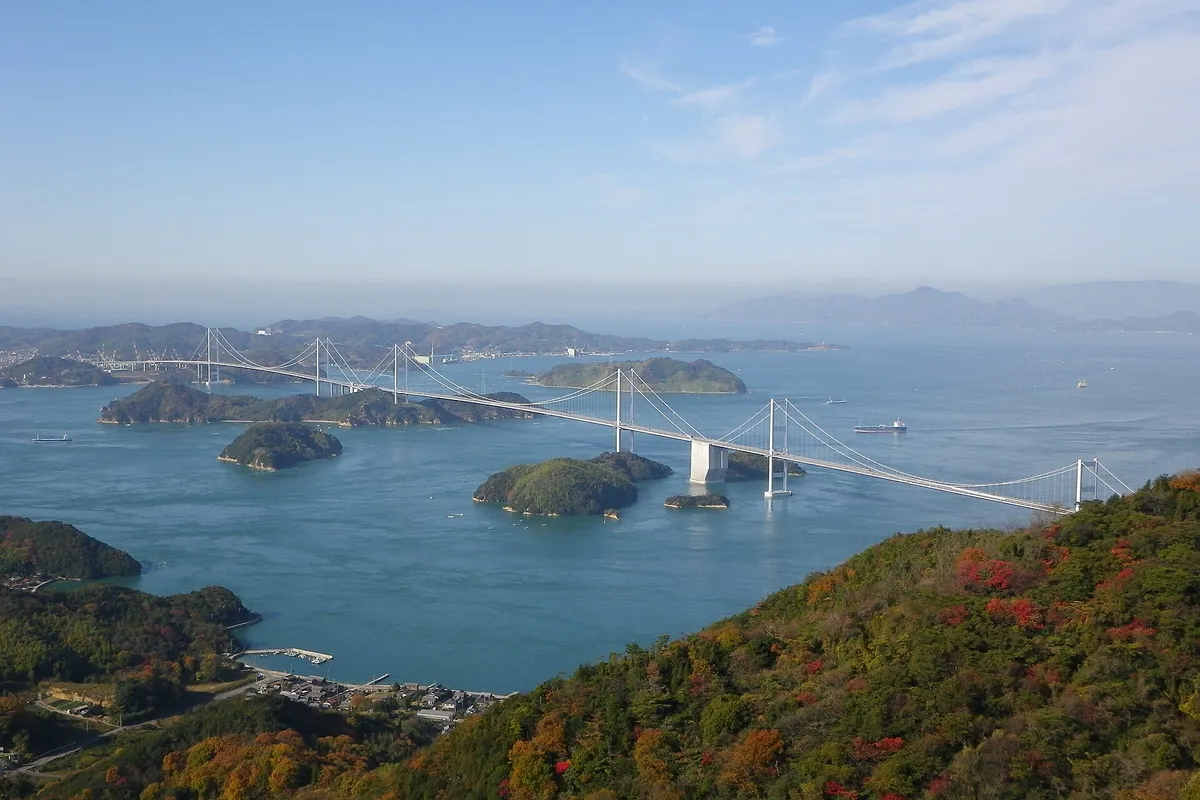
The photo of the Kurushima Kaikyo Bridge earlier was taken from Mount Kiro on Oshima, and more than a dozen of these voices mention Mount Kiro, also called Kirosan, by name. "大島の亀老山展望公園からのパノラマは特に素晴らしいです。" (The panorama from Kirosan Observation Park on Oshima is especially wonderful), wrote a reviewer who drove. Riders write that it's a hard climb by bicycle. "Kirosan is alot harder with a regular bike", one wrote.
The Japanese government named the route one of the country's National Cycle Routes in November 2019, and it describes the route as Japan's first cycling route across a strait. At the Omishima end of Tatara Bridge there's a "Cyclists' Sanctuary" monument, which commemorates a cycling event held in 2014 and an agreement linking the road with Sun Moon Lake in Taiwan.
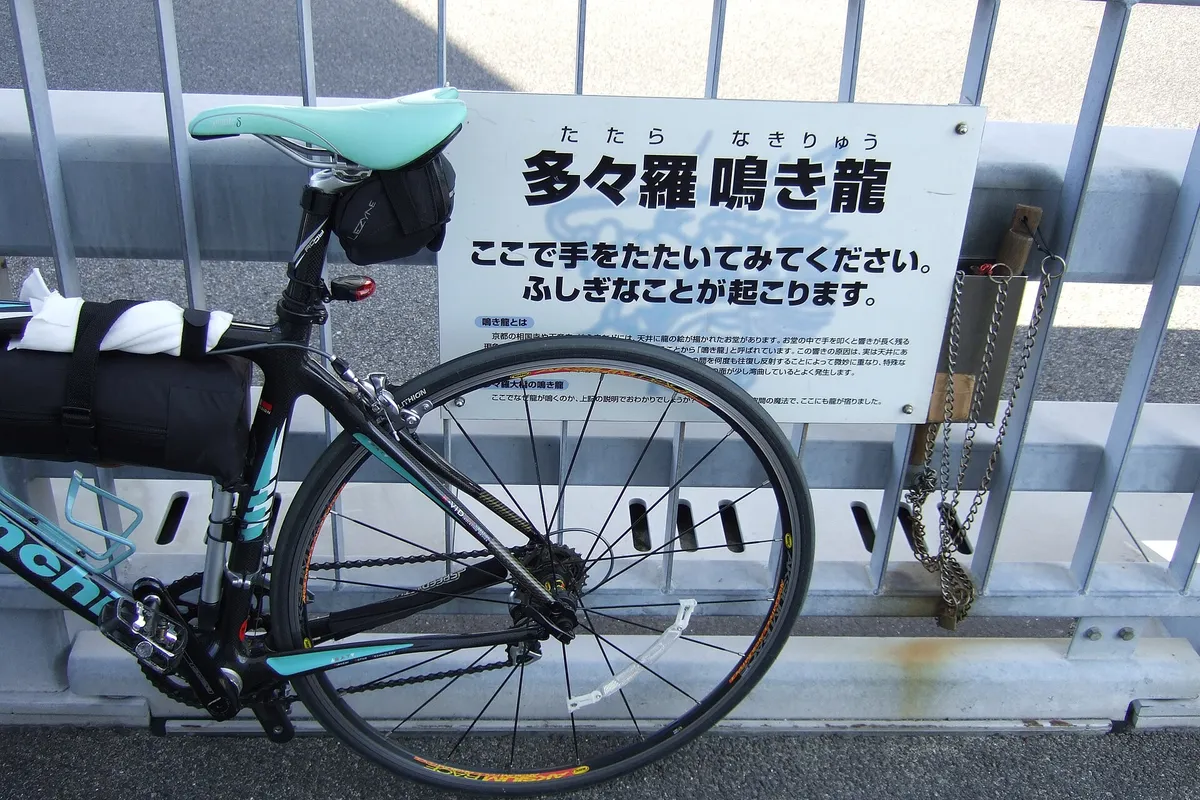
Shimanami Japan says that if you clap your hands directly under the main tower of Tatara Bridge, the sound echoes up into the sky, and it calls this the Naki-ryu, the crying dragon. A reviewer who drove parked at the roadside station, walked out to it and wrote "とても良かったです。" (it was very good).
Doing it well, the welcomed way
Shimanami Japan suggests a beginner plan on about 10 km an hour, 30 km in a half day and 50 km in a day, and says riders used to cycling can do the full route in 6 to 8 hours. Its model courses include Setoda to Omishima over Tatara Bridge (about 9 km, one hour), Imabari to Oshima and back (about 13 km, 1.5 hours) and Onomichi to Setoda with a ferry back (about 30 km, 3 to 4 hours). One rider who did about half and took the ferry wrote "it's still amazing and more comfortable than trying to squeeze too much in". Shimanami Japan says you can also carry a bicycle back by bus or boat.
People differ on how many days they'd take. One rider wrote "I'm very happy we did it over two days", and a rider on the Taiwanese forum who took two days and one night wrote "還是太趕" (it was still too rushed). Others did it in one day. A rider on a rented cross bike wrote "I just did the whole 70km in about 7 hours" and called it a great experience, though the rider felt quite sore towards the end.
Shimanami Japan's rate for an adult's cross or city bike is 3,000 yen a day, or 1,000 yen for children of elementary-school age and under. It also rents two kinds of bicycle with a motor, for adults only. A power-assisted bicycle costs 4,000 yen a day. An E-bike costs 8,000 yen, needs a height of at least 145 cm and has to be returned the same day. Each is kept only at some terminals. Helmets are free with a rental, and Shimanami Japan asks every rider to wear one. Riders also mention other rental shops.
Some riders wish they had chosen a bicycle with a motor. "my biggest mistake was not getting an E-bike", wrote a rider who went in 2022. Those who chose one write about it too. A reviewer who rode e-bikes in May 2026 wrote "I'd definitely say e-bikes are worth it". A Japanese reviewer who never tired thanks to an electric bicycle in 2021 felt the rental fee was far too high.
The maker's catalog figures for the standard power-assisted bicycle are 62 km in power mode and 200 km in eco mode, which Shimanami Japan says vary with slope and load, and you can swap their batteries at the two Setoda terminals and at Omishima. Several riders who wrote about saddle pain suggest padded shorts.
Shimanami Japan has ten rental terminals, and you can return a bicycle at a different one from where you rented it. If you plan to return it somewhere else, ask about any drop-off fee when you book. It says you can change where you return it partway through because of the weather or how you feel. The terminals at Onomichi Station and in Imabari are open from 8:00 to 19:00 from March to November and from 8:00 to 18:00 from December to February, and those on the islands from 9:00 to 17:00. Bicycles have to be back during opening hours, and Shimanami Japan doesn't allow riding at night, so it helps to check your return time first and plan your day from it.
Shimanami Japan says rental bicycles don't always have a basket and asks you to carry as little as possible. Its site lists same-day luggage delivery to your lodging, and coin lockers along the route. One rider, sore and carrying a 7 kg backpack, pushed the bike up to the last two bridges.
At the Onomichi end, the bridge company recommends the ferry, because Onomichi Bridge is narrow with heavy traffic and Shin-Onomichi Bridge has no path for bicycles. One rider on Reddit who went in 2024 wrote that the ferry was cash only. A Japanese reviewer who rode in July 2020 wrote about payments on the islands too, "現金も必ず持参しましょう" (be sure to bring cash too).
Shimanami Japan counts about 140 rest stops called Cycle Oasis on one page and more than 150 on another. These are places like inns and gas stations, where you can rest, get water and use the toilet. It also suggests a "こんにちは" (hello) as you pass someone, or a word of encouragement when you overtake on a climb. One reviewer from Illinois wrote "Everyone we met along the route were incredible nice and friendly!"
Riding considerately is appreciated. A Japanese reviewer wrote about riders overtaking families with small children on the bridges without slowing down, and asked for a rule of single file with no overtaking there to be promoted. The bridge company asks cyclists to keep to the left in single file, and on Ikuchi, Tatara and Kurushima Kaikyo Bridges, where the path is shared with people on foot, to give way to them. Shimanami Japan says bicycles belong at the left edge of the road, and that on sidewalks open to bicycles you stay on the side nearest the road, go slowly and leave room for people on foot. It also asks groups of five or more to split in two, and lists riding with an umbrella or a phone in your hand as something you can be fined for.
How the ride feels depends on when you go. A Japanese reviewer who went in mid-August wrote of their own timing that it was "大馬鹿者のすることです。" (what a complete fool does), got through a 2-liter bottle every two hours, and still called it a good memory. Another who rode in July found little shade and wrote about taking proper breaks for water. In January, one rider from abroad wrote "I liked doing it with hardly any other tourists around", and a Japanese reviewer who went that month found that good weather and the slopes kept the cold away. One rider on the Taiwanese forum found the end of February too cold.
Shimanami Japan asks you to bring a raincoat on days when rain is possible, and the bridge company says wind can be strong over the straits. In June 2026, heavy rain had closed the cycling route from Mukaishima to Oshima and part of the expressway on the morning of June 25, and both were open again by 23:00 on June 26. The bridge company's site lists closures.
If you're driving, you pay expressway tolls, and some reviewers note that tolls add up as you get on and off. One who came during Golden Week, Japan's spring holidays, in 2019 got stuck in a jam of more than 20 km on the way back. A reviewer points out that you can't stop on the bridges on the toll road.
Motorbikes of 125cc or less use a path on the bridges away from the cars, shared with bicycles on some bridges, and the free passage doesn't cover them. The bridge company lists tolls of 50 to 200 yen a bridge, or 500 yen for all six. Reviewers on small motorbikes write about stopping mid-bridge to take in the view, and one who hadn't brought coins had to ask a shop for change.
People who took the bus don't all feel the same about it. A reviewer who rode a route bus from Innoshima to Onomichi found the bridge worth seeing, while one reviewer found crossing between the islands by bus very inconvenient and another found the service poor.
Crossing the bridges may feel scary if heights bother you. "I was whiteknuckling my handlebars for the whole bridge since I'm afraid of heights" (gripping them tightly in fear), wrote a rider about the final bridge to Imabari, and still loved the ride.
Planning your time around the Inland Sea? Is Onomichi worth it collects voices on the town at the start of the route, and is Hiroshima worth it does the same for Hiroshima, which some riders visit before or after. The Hiroshima Peace Memorial guide and the Dogo Onsen guide cover the places on either side. For how we think about choosing what to do in Japan, see what actually matters.
Sources
- Shimanami Japan, rental rates (レンタサイクルについて): cross or city bike 3,000 yen a day for adults and 1,000 yen for elementary-school age and under, power-assisted bicycle 4,000 yen, E-bike 8,000 yen with same-day return and a height of 145 cm or more, free helmets, the maker's catalog ranges of 200 km in eco mode and 62 km in power mode for the standard model, battery swaps at the Setoda and Omishima terminals, the steep way down from each bridge, no riding at night, and sidewalks open to bicycles.
- Shimanami Japan, terminal information (ターミナル情報): ten rental terminals, returning at a different terminal or changing it on the way, and terminals open from 8:00 to 19:00 from March to November and 8:00 to 18:00 from December to February at Onomichi Station and Imabari, and 9:00 to 17:00 on the islands.
- Shimanami Japan, for first-time riders (初めての方へ): beginner pace of 10 km an hour, 30 km in a half day and 50 km in a day, more than 10 hours for 70 km, 6 to 8 hours for riders used to cycling, about 140 Cycle Oasis stops, coin lockers, raincoats and baggage, riding rules, carrying a bicycle back by bus or boat, and greetings.
- Shimanami Japan, model courses (モデルコース): courses of about 9 km, 13 km, 18 km, 30 km and 70 km, with times, and the Cyclists' Sanctuary monument past Tatara Bridge.
- Shimanami Japan, what the cycling road is (しまなみサイクリングロードとは): about 70 km and the first bicycle road across a strait in Japan, and the Cyclists' Sanctuary monument and the events of 2014.
- Shimanami Japan, why cyclists choose the Shimanami Kaido (選ばれている4つの理由): the blue line between JR Onomichi Station and JR Imabari Station, more than 150 Cycle Oasis stops, and same-day luggage delivery to lodging.
- Shimanami Japan, home page (しまなみジャパン): clapping under the main tower of Tatara Bridge and the Naki-ryu.
- Shimanami Japan, closure for heavy rain, June 25, 2026 and closure lifted, June 27, 2026: the cycling route from Mukaishima to Oshima and the expressway from Nishiseto-Onomichi IC to Oshima-Minami IC, as of 7:00 on June 25, and open again as of 23:00 on June 26.
- Honshu-Shikoku Bridge Expressway Company, Shimanami Cycling Free (しまなみサイクリングフリー): free passage for bicycles until March 31, 2028, not including mopeds, and closure information.
- Honshu-Shikoku Bridge Expressway Company, moped and bicycle paths (原付道・自転車歩行者道): paths for pedestrians, bicycles and mopeds of 125cc or less on the bridges, single-file riding on the left, giving way to pedestrians on Ikuchi, Tatara and Kurushima Kaikyo Bridges, strong winds over the straits, moped tolls of 50 to 200 yen a bridge and 500 yen for all six, no path on Shin-Onomichi Bridge, and the ferry recommended instead of Onomichi Bridge.
- Honshu-Shikoku Bridge Expressway Company, press release of March 13, 2026: the two-year extension to March 31, 2028, and the National Cycle Route designation of November 2019.
- Ministry of Land, Infrastructure, Transport and Tourism, Shimanami Kaido cycling road: the National Cycle Route entry, a length of 70 km between JR Onomichi Station and Sunrise Itoyama, and Japan's first cycling route across a strait.
Reviews and posts are voices, so they aren't listed as sources here. Dates and prices in them are as the writers gave them: trips or posts from 2019, 2020, 2021, 2022, 2024, 2025 and 2026, a rider's 7 kg backpack, and a Japanese reviewer's 2-liter bottles.
WMJS is written in Japan, in English, with AI help. We check every page, but English is not our first language. If a sentence reads oddly, tell us. One sentence is enough.
Thank you. A person reads every note.
How well do you know Japan?
Built from 635 public posts by Japanese people
Want to know more? Ask Japanese people
Have a follow-up question about this topic? We'll ask real Japanese people.
Voice Box →