
Is Osaka Aquarium Kaiyukan Worth It? What 163 Real Visitors Say
You've probably already seen the picture: a whale shark gliding past a wall of glass, tiny against a tank so big it barely fits in the frame. That's the pitch for Osaka Aquarium Kaiyukan, "one of the world's largest," usually the second stop on the list after Osaka Castle, or the answer to "what do we do if it rains." Then you get there, pay a ticket price that changes by the day, and start walking down a single long ramp that seems to circle the same enormous tank again and again. Is that the aquarium being repetitive, or is that the point?
Here's what the voices below add up to: most people call it worth it, and the ones who don't are usually describing the exact same ramp and tank that the happy ones just described in the opposite direction.
Is it worth it? (in visitors' own words)
We gathered the voices of international travelers who have actually been to Kaiyukan and read them with one question in mind: was it worth it? Here is how they fell:
Read the praise and the complaints side by side and you notice they're often describing the exact same walk. One traveler, delighted: "The flow of the aquarium was cleverly designed to start at the top, and visitors just have to follow the rounding slopes down and exit at the bottom. A relaxing walk." Another traveler hit that same slope on a crowded day and had a rougher time of it, but also worked out the fix himself: "It's basically a big snake path that wraps around the huge central tank and a lot of people pile up as soon as they see the big tank. So if it's super crowded, push your way past the people and it'll probably thin out way more further on with just as good a view of the tank (if not better)." Same ramp, same tank. One person's relaxing descent is another person's bottleneck, and the difference usually comes down to what time they arrived and whether they kept moving instead of fighting for a spot at the very first window.
The whale sharks are the anchor almost everyone mentions. "The main attraction is the center tank, which you slowly work your way around and down. In this tank you will see a variety of larger species (including my favorite, the giant sunfish), but the main draw here is a pair of whale sharks. I have never seen a whale shark in captivity before, and I have visited a lot of aquariums around the world." When people say the ticket was worth it, this is usually why.
Where to buy: official site / Klook
Klook is an affiliate link: if you buy through it, we may earn a commission, at no extra cost to you.
How Japanese visitors and locals really feel
Now for the layer almost no travel guide includes: Japanese visitors, reviewing the same aquarium in their own words on jalan.net and on minhyo.jp, a site built specifically to collect the blunt, critical opinions that a typical star rating smooths over.
That red band is weighted by how much each account resonated with other readers, and it lands at roughly two and a half times the size of the international visitors' one. It doesn't mean three in ten Japanese visitors regret going. Most of the weight in it comes from a handful of accounts about staff conduct that a lot of other readers clearly recognized, alongside a smaller thread of visitors who found the route genuinely repetitive: "I've been to many aquariums, and this is the most boring one. You're shown the same cylindrical tank endlessly. People get bored quickly, so only the entrance end of the corridor around that tank has any crowd." Another, more bluntly: "Only the tank is big, and you're shown the same creatures the whole way through, I got bored in the end."
The single most-upvoted negative review in the whole Japanese corpus is not about the fish at all. It describes a lost handkerchief: "A security guard was walking around holding a handkerchief I'd dropped, and just as I was about to call out to him, he threw it straight into the trash right in front of me... No apology from the guard, who acted like it wasn't his problem." A parent separately recounts being scolded, without softening, for how she stood with her young son on a single-file escalator. It's a frustration that barely surfaces in the foreign reviews, and probably for a simple reason: visitors from abroad aren't necessarily expecting the level of front-line politeness that's the baseline in Japan, so they don't notice as sharply when a staff member falls short of it.
What sits underneath both bands, though, is a current of real affection from people who keep coming back. "To me, Kaiyukan basically is what 'aquarium' means, I love this place. It starts with a mountain-stream exhibit and gradually descends toward the sea, finally reaching the deep sea. The exhibit follows the path of a river's flow, which is lovely." A father, watching his daughter: "The big tank is indeed Kaiyukan's signature feature, and watching all sorts of fish swimming in it, my daughter will stand still in front of it for over an hour. I don't get bored watching either, so I stay and watch with her."
What we wish you'd noticed
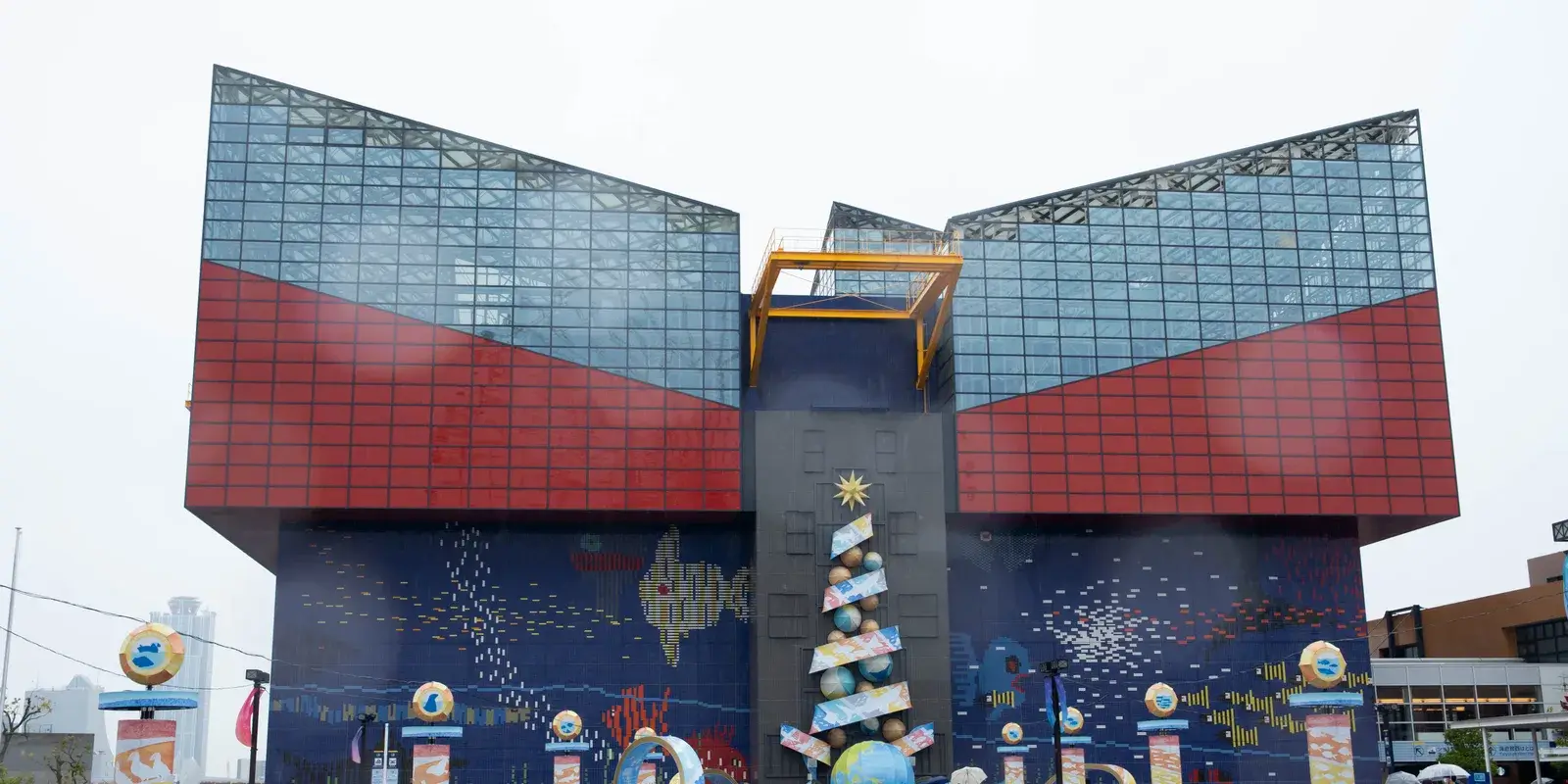
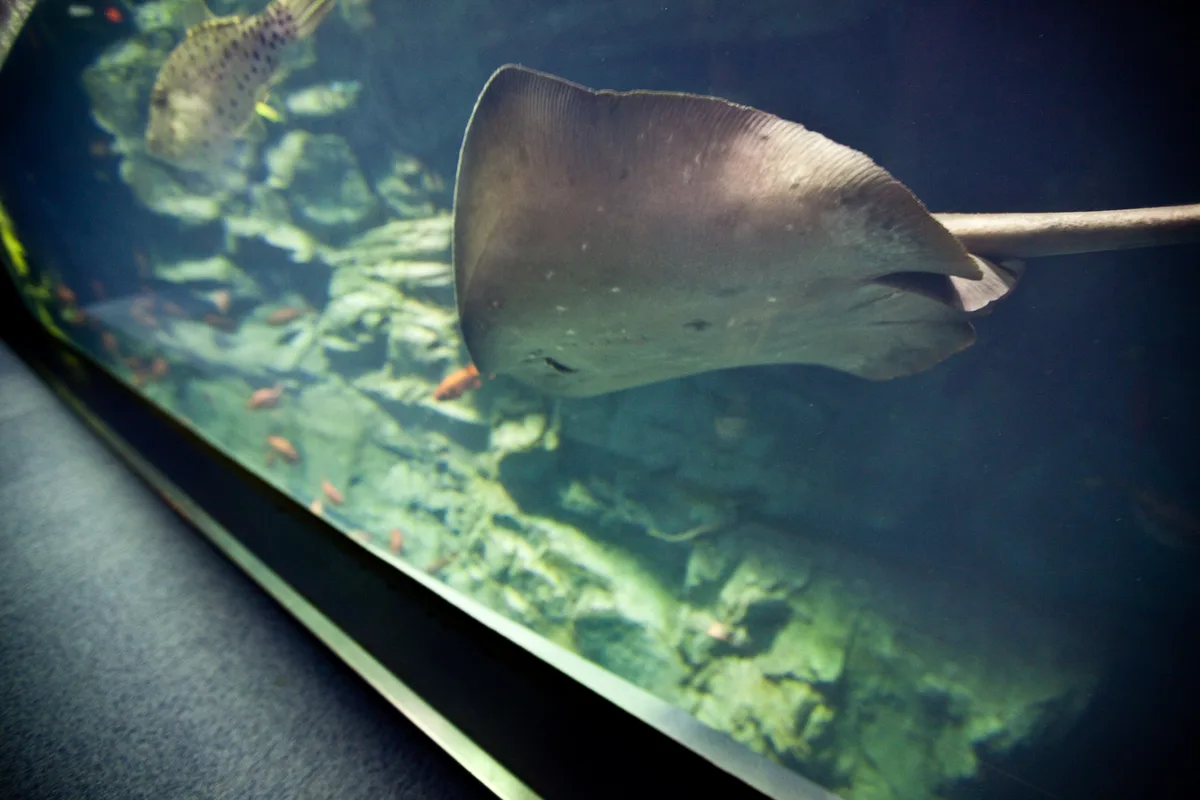
Kaiyukan's exterior tells you its concept before you've bought a ticket: the building is banded in blue for what the aquarium calls the "Ring of Life," the ocean, and red for the Pacific's "Ring of Fire." Inside, the whole route is built around a single Pacific tank roughly 34 meters across and 9 meters deep. An elevator lifts you to the eighth floor, and from there one continuous ramp spirals down past a sequence of smaller regional tanks, a Japanese forest, the Aleutian Islands, Monterey Bay, Antarctica, before delivering you to the big tank itself, which you then pass on three separate floors at three different depths. It is one tank, seen three times, not a hallway of separate exhibits repeating itself on you. Nippon.com, describing the same walk, calls the sensation of that descent something close to diving, floor by floor, into the ocean. Visitors who expected a sequence of different tanks tend to read the third pass as filler. Visitors who clock what's actually happening tend to call it the best part of the building.
The price complaints and the size complaints are often the same complaint wearing two names. Kaiyukan uses dynamic pricing: the aquarium's own admission page sets the adult ticket at a price that moves with demand rather than a single fixed number, so what you pay for the same visit can differ from one date to the next. If the cost matters to you, checking the aquarium's own price calendar before picking a date does more to fix this than anything else on this page.
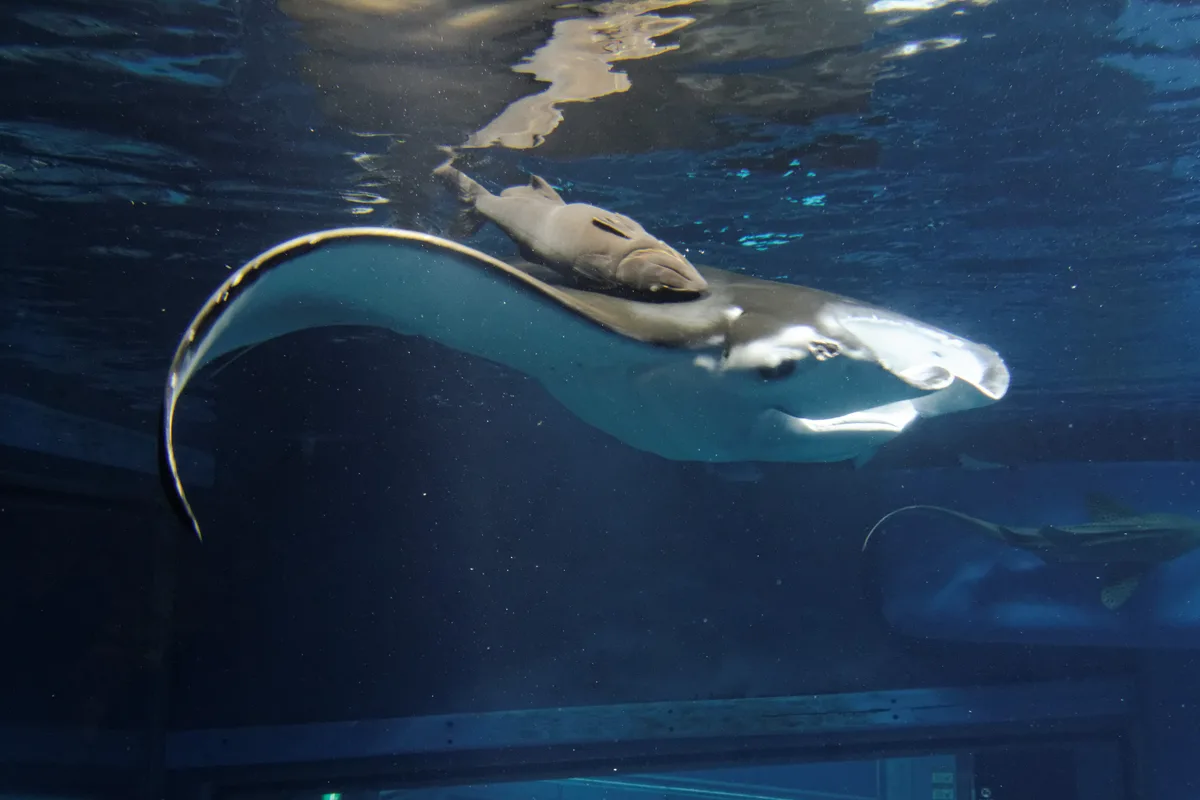
The whale sharks have names. As of the aquarium's most recent public account, in April 2026, they were Yu, a female about 18 or 19 years old and 6.2 meters long, who has lived at Kaiyukan since 2014, and Kai, a male about 8 or 9 years old and 5.3 meters long, since 2024. Both arrived after being caught in fixed fishing nets off Kochi Prefecture and transported to the aquarium in special containers. Staff feed them twice a day, and a few visitors who happened to time their visit around a feeding call it the highlight of the trip. There's no published feeding schedule to plan a visit around, so treat it as a bonus rather than something you can engineer, and ask a staff member if one is coming up soon.
Getting the good version of this visit
A few concrete choices make the good version of this visit the likely one.
- Buy a timed e-ticket before you go. One visitor recalls aquarium staff telling her a same-day counter ticket can mean a two-to-three-hour wait on a busy day. An e-ticket with a set entry time is the single change several reviewers wish they'd made in advance.
- If the first viewing window at the big tank is packed, keep walking. The tank runs across three floors, and the view a level or two further down the ramp is frequently just as good, or better, with far fewer people in front of you. It's exactly the advice the crowded-slope traveler above gave himself, a little too late.
- Ask about feeding times when you arrive. There's no fixed public schedule, but staff know the day's timing, and catching the whale sharks being fed is what several visitors, foreign and Japanese alike, single out as the moment that stuck with them.
- Check the price calendar if the ticket cost matters to you. Because pricing moves with demand, a weekday or an off-peak date can be noticeably cheaper for an identical visit.
- Keep your ticket after you leave. It doubles as a discount coupon at the neighboring Tempozan Marketplace, whose food court and the giant Tempozan Ferris Wheel next door make an easy second half of the day if you came expecting a quick rainy-day stop.
- Budget two to three hours. That's what most visitors report needing to see it properly; treat it as a focused visit and pair it with something else nearby rather than planning around it as a full day out.
Where to buy: official site / Klook
Klook is an affiliate link: if you buy through it, we may earn a commission, at no extra cost to you.
The tank isn't repeating itself on you. It's one enormous window into the Pacific, built to be walked past three times on the way down, and the visitors who know that going in are consistently the ones who enjoy the walk.
None of the rest needs to be left to chance. Book the timed ticket, keep moving if the first window is crowded, and go in already knowing what you're looking at. Most people who've made that walk before you come out the other end glad they did, and the ones who don't usually say, afterward, that they'd have arrived an hour earlier if they'd known.
Deciding what else belongs on an Osaka itinerary? See how Osaka Castle and Dotonbori hold up to the same kind of scrutiny, or start with what actually matters in Japan.
Sources
- Osaka Aquarium Kaiyukan, Admission Fees and Other Tickets: official dynamic-pricing admission page; the ticket also functions as a Tempozan Marketplace discount coupon.
- Osaka Aquarium Kaiyukan, Business Hours and Closing Days: official opening-hours and closing-day calendar.
- Osaka Aquarium Kaiyukan, official homepage: e-ticket system, first-time-visitor guidance, barrier-free information.
- Nippon.com, "A Deep Dive into Osaka Aquarium Kaiyūkan: Home to Whale Sharks and Ringed Seals" (2021-09-10): opened 1990; Ring of Life/Ring of Fire building design; one-way route from the 8th floor past regional tanks; central Pacific tank dimensions (34m across, 9m deep, spanning multiple floors); the descent described as a sensation of diving deeper into the ocean.
- The Japan News (Yomiuri Shimbun), "Osaka: What Might These Adorable Whale Sharks Be Saying at Kaiyukan Aquarium?" (2026-04-18): whale sharks Yu (female, 6.2m, about 18-19 years old, at Kaiyukan since 2014) and Kai (male, 5.3m, about 8-9 years old, since 2024); twice-daily feeding; both caught in fixed fishing nets off Kochi Prefecture.
WMJS is written in Japan, in English, with AI help. We check every page, but English is not our first language. If a sentence reads oddly, tell us. One sentence is enough.
Thank you. A person reads every note.
How well do you know Japan?
Built from 635 public posts by Japanese people
Want to know more? Ask Japanese people
Have a follow-up question about this topic? We'll ask real Japanese people.
Voice Box →