
How Japan Works
Is Tsutenkaku Worth It? What Visitors From Abroad and From Japan Say About Osaka's Retro Tower
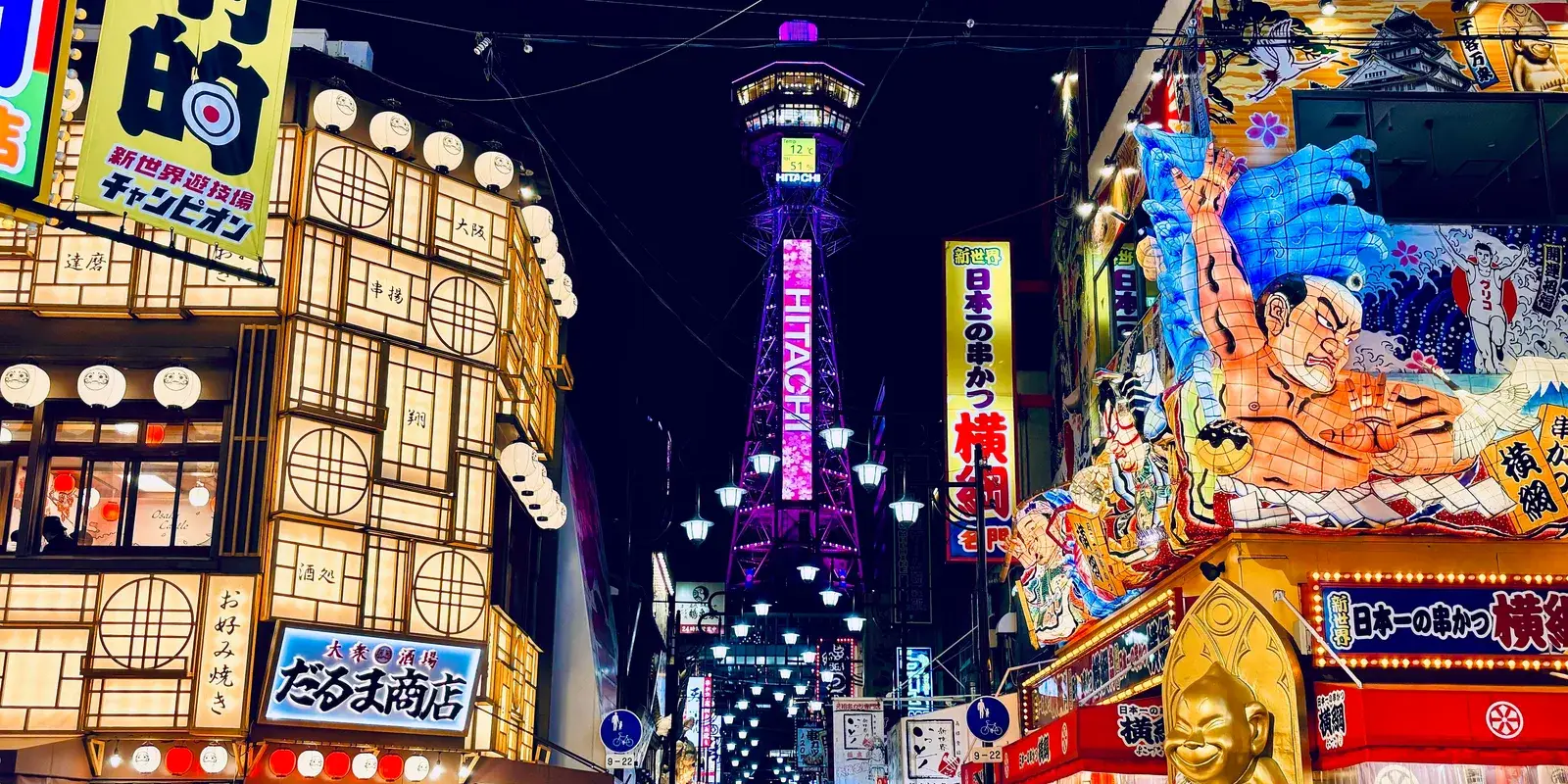
Tsutenkaku, the 100-meter tower in Osaka's Shinsekai district, is the second tower of that name, built in 1956. We gathered 452 voices from people who went there, and most of them say it was worth it: 68% of the 273 international voices and 75% of the 179 Japanese ones are in that band. Waiting in line is mentioned in 48 of the 273 international voices and 48 of the 179 Japanese ones. Among the voices that mention a wait, 20 of the 48 international ones are in the red band, compared with 4 of the 48 Japanese ones.
Is it worth it? (in international visitors' own words)
We gathered reviews and posts from international visitors who went to Tsutenkaku, on TripAdvisor, Google Maps, a Taiwanese travel board, Reddit, and a travel forum, and sorted them by how they felt about the visit.
The red band is small, 38 of the 273 international voices, and 19 of those 38 give the waits as a reason. A visitor from Melbourne wrote the review while still in line: "Writing this in the 6th Que we’ve been in for the last hour. The Que outside at the bottom might look short but it goes through a warren of tunnels and takes ages." A Google Maps reviewer in October 2026 described the same surprise: "The line from outside doesn’t look too long until you realize that isn’t even a fraction of the line that you’ll stand in."
Other complaints appear alongside the waits or in their place. 8 of the 38 object to the souvenir shops and photo sales on the way up and down, 4 describe rude staff, and 3 say that at night the lights inside the tower spoiled the view through the windows.
13 of the 49 voices in the middle band find the view ordinary or the tower low. Across all 273 international voices, 26 say this, and the other 13 of them are split between the green and red bands. One Google Maps reviewer in the middle band told readers "don't expect great views since it's not a particularly tall tower," and still called the place, with its street food and games around the tower, "a fun tourist spot." 24 voices mention a sightseeing pass such as the Osaka Amazing Pass, and 8 of them tie their visit or their verdict to the pass. Some say going up was worth it because the pass included it, and others say the same about the slider or Dive & Walk, or that they would not have paid for it otherwise. The official pages do not say which attractions each pass covers today, so check the pass's own terms before you count on it. A visitor who arrived at opening time with the pass found no wait at the observation deck and wrote: "Not sure if I would visit if I would have to pay, but because it was part of the Osaka Pass definitely worth it."
19 of the 48 international voices that mention a wait are in the green band. "Long wait in line but very worth it when you reach the top," wrote one Google Maps reviewer, and another, who waited 20 to 30 minutes on a Saturday, called it "well worth the wait!"
How Japanese visitors feel about the same tower
Japanese visitors write about the same tower in their own reviews on Google Maps, jalan, and 4travel.
The Japanese reviews describe the same lines. 48 of the 179 mention waiting, and some of the waits they report are long: an hour on a Saturday afternoon, 70 minutes on a Sunday morning for the slider and the tower together, 90 minutes during the Golden Week holidays. 32 of those 48 are still in the green band. One reviewer who had a pass and skipped the ticket line still spent an hour inside the building before reaching the deck, and wrote: "The observation deck feels higher than it looks from outside, and you can take in Shinsekai and the area around Tennoji in one view, and I thought the wait was worth it." The same reviewer took off one star for standing the whole hour. Another, who waited 70 minutes for the slider and the tower together, wrote that "listening to other people's screams on the slider I didn't mind the wait."
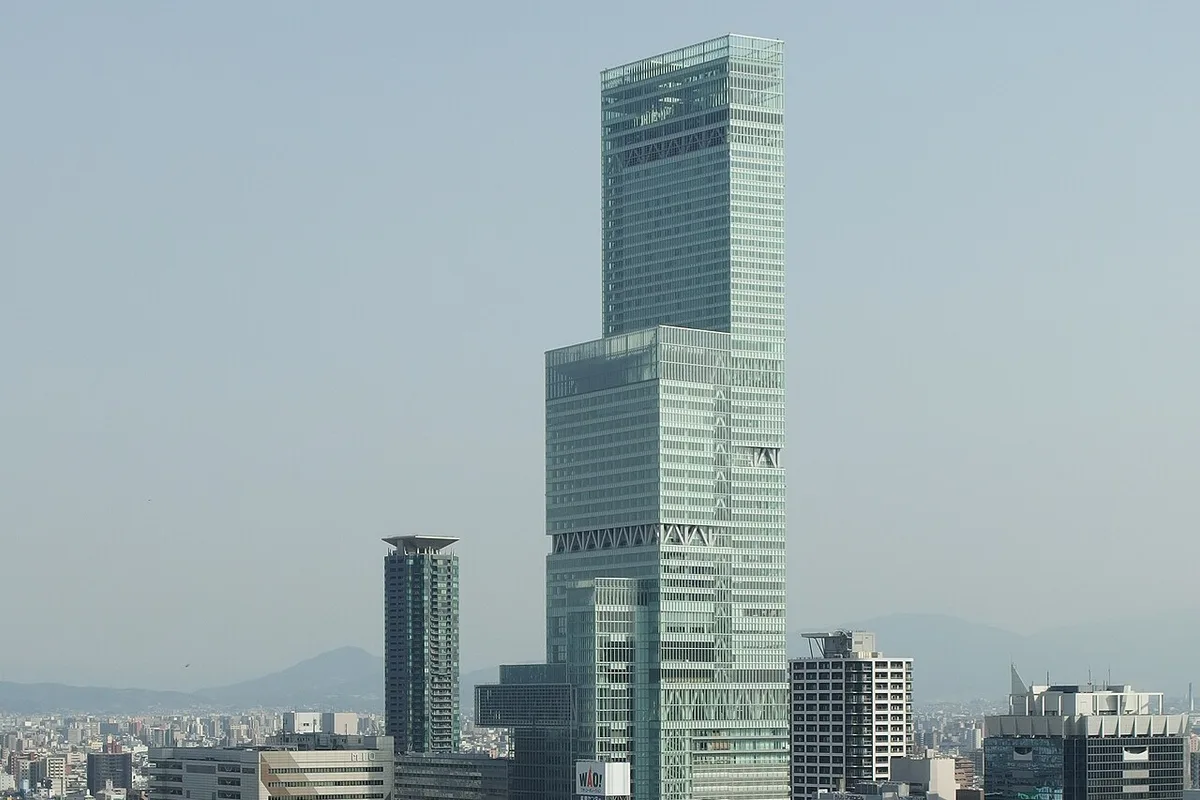
The 8 Japanese reviews in the red band include 4 about the waits. One visitor holding a timed ticket was told the wait would be 40 minutes, gave up, and went to Abeno Harukas, the skyscraper nearby: "I could guess it would be jammed even after getting inside, so I judged it wasn't a good use of time." Two describe rough handling by the staff. One felt moved along as if on an assembly line, and the other, also among the four about waiting, compares being put into the elevator to packing luggage. The other three are about high prices and closed shops, the commercial feel inside, and a night visit in 2022, when the reviewer thought Covid had closed many shops.
Many Japanese reviews write about the tower itself. Billiken, the lucky figure on the observation deck whose feet visitors rub, is mentioned in 35 of the 179, and the open-air deck at the top is mentioned in 34. One reviewer wrote: "It's not as tall as Skytree or Abeno Harukas, but for the satisfaction of “I've come to Osaka!” it's number one." The same reviewer described the full visit as the view from the deck, a scream on the slider, and kushikatsu in Shinsekai afterward. 27 reviewers write that they were coming back to the tower or to Osaka after years away, or that they had been before.
Before you go
What visitors answered
Buy tickets in advance?
108 people answered on Google Maps (October 14 – November 3, 2026)
- Yes40
- No37
- Not sure31
How long they waited to get in
109 people answered on Google Maps (October 14 – November 3, 2026)
- No wait50
- Up to 10 min21
- 10–30 min18
- 30–60 min14
- 1 hr or more6
These are answers to the questions Google Maps asks alongside a review, counted from the newest reviews of this place in every language. They are counts of answers, not a survey, and waits change with the day and the season.
What we wish you'd noticed
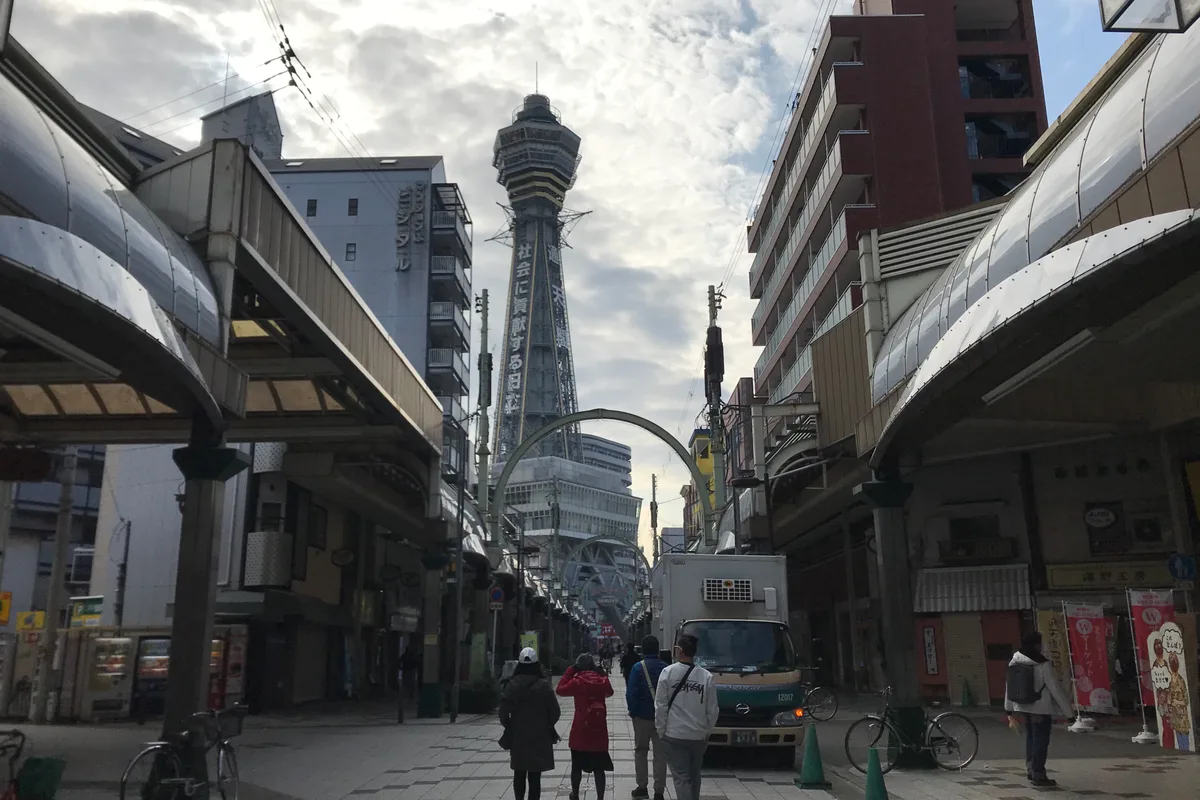
The first Tsutenkaku went up in 1912 beside an amusement park called Luna Park, on the site of a 1903 national industrial exhibition. According to the tower's operator, it looked like the Arc de Triomphe in Paris with the top half of the Eiffel Tower set on it, and at 75 meters it was the tallest tower in Japan at the time. It was taken down in 1943 after a fire in a cinema at its base. People in the neighborhood pushed to bring it back, a company was set up in 1955 with money from local residents, and the second tower opened in 1956. Its designer, Naito Tachu, also designed Tokyo Tower. The second tower marked its 70th anniversary on October 28, 2026.
The tower itself is 100 meters tall, and its decks sit lower than that. The two indoor floors are at 84 and 87.5 meters. The fourth floor turns into a disco at night, with flashy lighting and a mirror ball, and the golden fifth floor is where Billiken sits. Billiken was created in 1908 by an American artist, Florence Pretz, who modeled the figure on a god she had seen in a dream, and the statue on the deck today is the third, in place since 2012. Above these floors, stairs lead to Tenbo Paradise, an open-air deck at 94.5 meters with nothing around it to block the view, and to a platform that juts out at 92.5 meters with a see-through floor at its tip.
From the decks, Japanese reviewers pick out Abeno Harukas, Osaka Castle, and Tennoji Zoo, which they look down on from the deck. One of them could make out a giraffe.
Doing it well, the welcomed way
Entry to the tower now works by timed reservation. The official site recommends buying an online ticket in advance, says that buying by the day before lets you go in at the time you chose, notes that there can still be a wait on the day, and warns that tickets for the evening sometimes sell out. If you have the Osaka Amazing Pass, the Osaka Rakuyu Pass, the Tanoshii Kansai Pass, or an exchange voucher, you reserve your entry time at the ticket counter on the day. 16 of the Japanese reviewers and 10 of the international ones mention booking ahead or holding a timed ticket. One Japanese reviewer who booked ahead and went in right after opening reached the deck "non-stop" and passed people still in line on the way out. A reserved time does not guarantee no wait. Another Japanese reviewer wrote that "even if you go at your reserved time for the observation deck, you end up waiting anyway."
Once inside, you take one elevator to the second floor and a second elevator up to the decks. International and Japanese reviewers both describe a separate line for each, and more lines for the elevators on the way down. The second floor is full of shops, and a Japanese reviewer suggested walking straight through it if you would rather not spend money.
The general observation deck is open from 9:00 am to 9:45 pm, with last entry at 9:15 pm. Adults pay 1,500 yen and children aged 5 to 14 pay 800 yen, and from December 30, 2026 to January 3, 2027 the prices are 1,800 yen and 900 yen. Tenbo Paradise is sold only as a set with the general deck. It closes without notice in rain, strong wind, or fog. Because it is reached by stairs, the operator does not admit wheelchair users or visitors who have difficulty walking to it, for their safety.
If you go at night for the city lights, the open-air deck is outdoors, away from the lights inside. 3 international reviewers found that the lights indoors spoiled the night view through the windows, and one of them pointed to the small outdoor section upstairs, reached after one more line.
The Tower Slider runs from the third floor, 22 meters up, down a 60-meter tube to the basement in about 10 seconds. It is a separate ticket, 1,100 yen for adults aged 15 to 65 and 600 yen for children aged 7 to 14, and riders must be at least 120 cm tall. It is not open to children aged 6 and under or to people aged 66 and over. Children aged 7 to 12 need a guardian aged 18 or over with them. Bags and phones go into free lockers, and everyone wears a helmet. Dive & Walk, a harnessed walk around the tower at 26 meters followed by a jump from about 40 meters, costs 3,000 yen for adults and 2,000 yen for children aged 9 to 14, starts from a separate building called Tsutenkaku Satellite, and is open to ages 9 to 65 with a height of at least 130 cm. Children cannot do it alone, and the guardian with them also needs a ticket. The Walk on its own is 1,500 yen for adults and 1,000 yen for children. Neither one includes entry to the observation decks.
The streets around the tower are free to walk, and 7 international reviewers say they did only that, without going up. 5 of those 7 are in the green band. "I didn’t go up to the observation deck, but the tower is surely better seen from a far," wrote one of them on Google Maps.
Tsutenkaku is a 3-minute walk from Exit 3 of Ebisucho Station on the Osaka Metro Sakaisuji Line, and a 6-minute walk from Dobutsuen-mae Station or from JR Shin-Imamiya Station.
To compare with another Osaka observation deck, see Is the Umeda Sky Building worth it?, and for more places where the voices and the expectations differ, see what actually matters in Japan. The Dotonbori guide below covers the Namba side of Osaka, a few subway stops north of Shinsekai.
Sources
- Tsutenkaku official website: timed entry reservation for all tickets, with online purchase in advance recommended and pass holders reserving at the counter on the day; news release of October 21, 2026 on the 70th anniversary of the second tower on October 28, 2026.
- Tsutenkaku official website, Hours and admission: general observation deck 9:00 to 21:45 with last entry 21:15; adults 1,500 yen and children aged 5 to 14 800 yen, and 1,800 yen and 900 yen from December 30, 2026 to January 3, 2027; Tenbo Paradise sold only as a set; evening tickets may sell out.
- Tsutenkaku official website, Floor guide: the Light Observatory (84 m) with lighting and a mirror ball at night, the Golden Observatory (87.5 m) with the third Billiken, the floors and elevators from the basement to the second floor and up to the decks.
- Tsutenkaku official website, Tenbo Paradise: the open-air deck at 94.5 m and the jutting platform at 92.5 m with a see-through floor; closure in bad weather; no entry for wheelchair users or visitors who have difficulty walking, because of the stairs.
- Tsutenkaku official website, Tower Slider: 60 m slide from 22 m to the basement in about 10 seconds; 1,100 yen for adults aged 15 to 65 and 600 yen for children aged 7 to 14; minimum height 120 cm; guardian required for ages 7 to 12; free lockers and helmets.
- Tsutenkaku official website, Dive & Walk: the walk at 26 m and the dive from about 40 m; 3,000 yen for adults; reception at Tsutenkaku Satellite; minimum height 130 cm.
- Tsutenkaku official website, History: the first tower of 1912 (75 m) and its removal in 1943; the second tower of 1956 built with local investment; designer Naito Tachu and Tokyo Tower; Billiken by Florence Pretz in 1908 and the third Billiken since 2012; tower height 100 m.
- Tsutenkaku official website, Access: walking times from Ebisucho, Dobutsuen-mae, and Shin-Imamiya stations.
WMJS is written in Japan, in English, with AI help. We check every page, but English is not our first language. If a sentence reads oddly, tell us. One sentence is enough.
Thank you. A person reads every note.
How well do you know Japan?
Built from 635 public posts by Japanese people
Want to know more? Ask Japanese people
Have a follow-up question about this topic? We'll ask real Japanese people.
Voice Box →