
Is Fukuoka Worth It? What the People Who Went Say, in Two Languages
Ask a travel forum whether Fukuoka deserves your days and you will get two confident answers in the same thread. One traveler spent four nights there and could not wait to leave. Another, in the same thread, had been twice and was planning to make it the base for their next trip to Japan. Both have been. Both are describing the same place.
So we counted. On one side, comments from international travelers who show, in their own words, that they have been. On the other, the reviews Japanese people leave in Japanese about the places a visitor to Fukuoka actually ends up. The short answer that came back: seven in ten of the visitors who went say it was worth it. The ones who did not are a small group, and half of them say the same thing.
Is it worth the trip? (in visitors' own words)
Eight people came away disappointed. Half of them reach for the same words: boring, bland, not much to do. One traveler, who had arrived on a wave of hype about the city, wrote: "When I got there, I struggled to actually find anything to do in Fukuoka city proper. As you said, daytime Fukuoka is mostly boring. There's not much to sightsee." Another put it more gently. "It's ultimately a modern, bland, functional place. Nice but unspectacular." Three of the remaining four give no reason at all. The last one is let down for the opposite reason: they went looking for ramen in Tenjin and found every place packed out.
The green bar does not argue with any of that. The people who loved Fukuoka almost never claim it has famous sights; they say the opposite and count it as the reason to go. "It does not have all the things you can see in Kyoto and isn't as big as Osaka," wrote one traveler, in the second-highest-scoring comment we found, "but for a slow-pace 2-3 days just enjoying a more laid back city with amazing food, I'd recommend to give it a go." Another compressed the whole disagreement into three sentences: "If you want IG Japan, skip Fukuoka. I go for the vibe, food, shopping and sites in that order. Loved Fukuoka."
The amber band is mostly people weighing Fukuoka against somewhere else on the same days: Nagasaki, Hiroshima, the wider Kyushu loop. One of them has been more than once: "been there a couple of times, id go again, it is a nice city. but its not a must-see place. theres many nice cities in japan."
What Japanese reviewers say about the same places
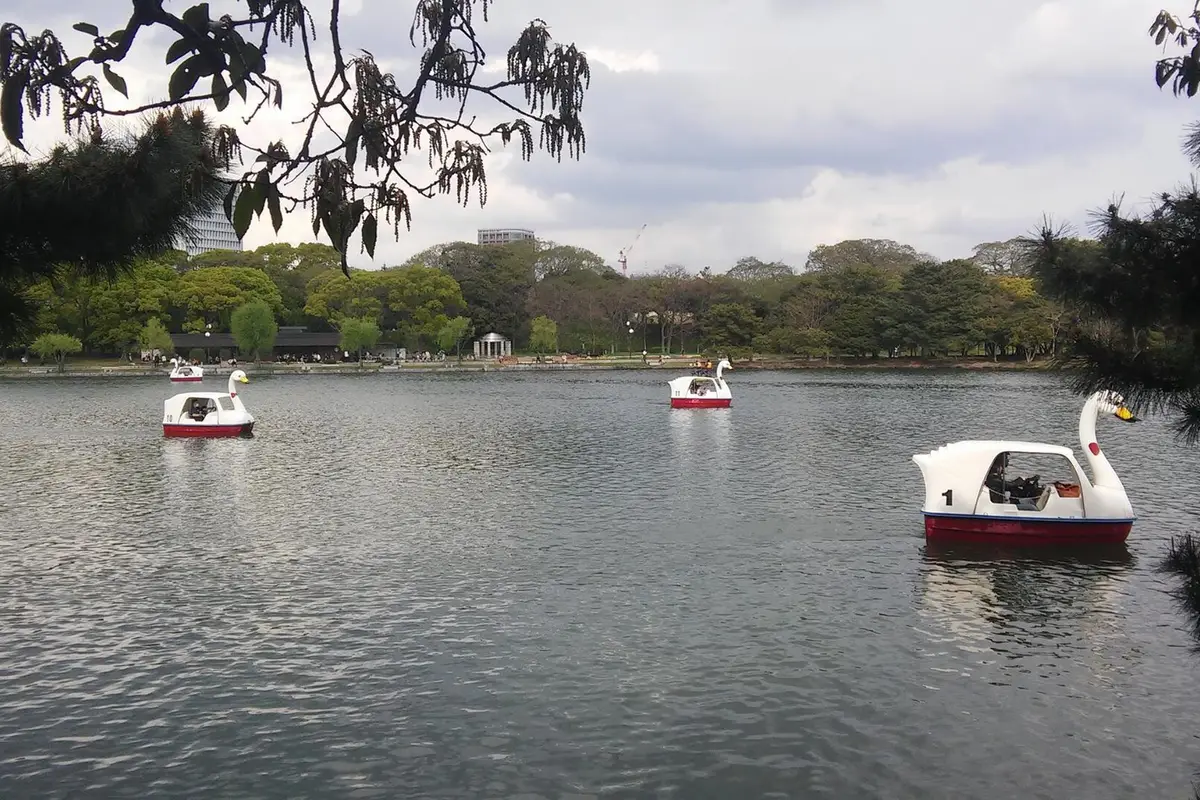
Two audiences, two languages, and the let-down bars land within a point of each other: 12% and 11%. What sits underneath them is another matter, and the first sign of it is an absence. Among the Japanese reviews we can read in full, exactly one makes the complaint that fills the foreign red bar, and it is about a shopping mall. Some of that absence is a matter of where these reviews live: every one of them was written about a particular park, shrine, tower, mall or stall, so nobody in this set was ever asked whether Fukuoka is worth a trip at all. What they were asked about, they answer at close range. A park on a Sunday, a shrine on the way to somewhere, an hour by the water. One reviewer wrote of Ohori Park: "It has become a place of rest for residents and tourists alike, with people running and people walking, and it was such a comfortable area to be in."
So where does that 11% of Japanese disappointment come from? Almost entirely from one thing, and it is the thing the city's own tourist guide puts at the front of its English pages.
The split inside the second bar
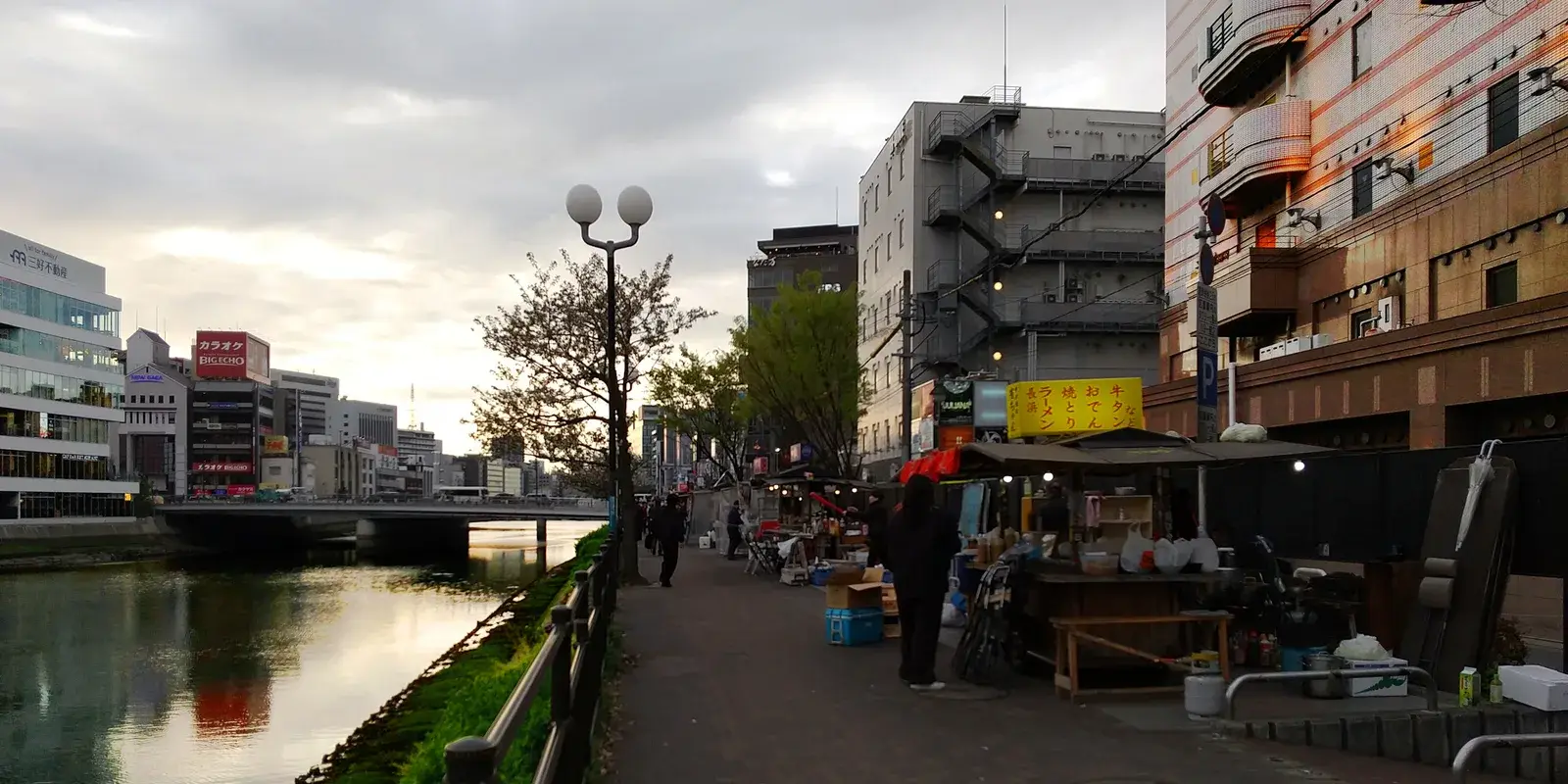
Fukuoka's food stalls, the yatai, are what the city's own tourist guide leads with. They are not, as it turns out, what the foreign green bar talks about most: seven of its forty-seven voices name the yatai, twenty-four name the food in general, and around twenty name the slower pace or the missing crowds. Sorted by what each Japanese review is actually reviewing, the same 238 voices divide like this:
| What Japanese reviewers were writing about | Glad they went | It depends | Let down |
|---|---|---|---|
| The yatai food stalls (149 reviews) | 52% | 33% | 15% |
| Everything else in the city (89 reviews) | 89% | 8% | 3% |
The park, the shrine, the tower, the mall: nearly nine in ten come away happy, and fewer than one in ten hesitates. At the yatai, between a quarter and a third of reviewers file the evening under it depends, depending on whether you count the truncated 4travel half, and the let-down rate is four to five times higher.
The hesitation in the two sets of voices sits in different places, then. The foreign let-down is about the city as a whole and how little of it there is to look at. The Japanese hesitation barely touches the parks, the shrine, the tower or the mall, and gathers almost entirely at the stalls, the part of the city its own guide puts first.
What the Japanese reviews mean by "it depends"
The reservations are specific and they repeat. Some reviewers do say they would not go back, or would not go alone again. Most of the rest are not arguing about whether to go at all. Two of them put the trade in almost the same terms.
"I had some odd expectations of the Hakata yatai, and it didn't live up to what I had imagined. That's how I feel now. As a yatai it passes, but comparing the food and the rest with a proper restaurant, well... that's my real feeling. If you want to eat well, go to a restaurant. If you want to enjoy the atmosphere, go to a yatai." And another, writing after a Sunday when both of the stalls they had chosen turned out to be closed: "Compared with an izakaya, the price per item is higher. It isn't that the food is delicious. It's the yatai atmosphere you're there to enjoy."
The rest of the Japanese hesitation is logistics. Reviewers are surprised by queues on ordinary weekday evenings. Around fifteen compare the number of stalls with what they had pictured or remembered, and about four in five of those run the same way: "I thought there would be more yatai lined up, but there weren't that many," wrote one. One reviewer who walked the Tenjin and Nakasu stretch on a Monday found stalls shut here and there, with the warning that a first-timer should not assume every stall opens at the same hour.
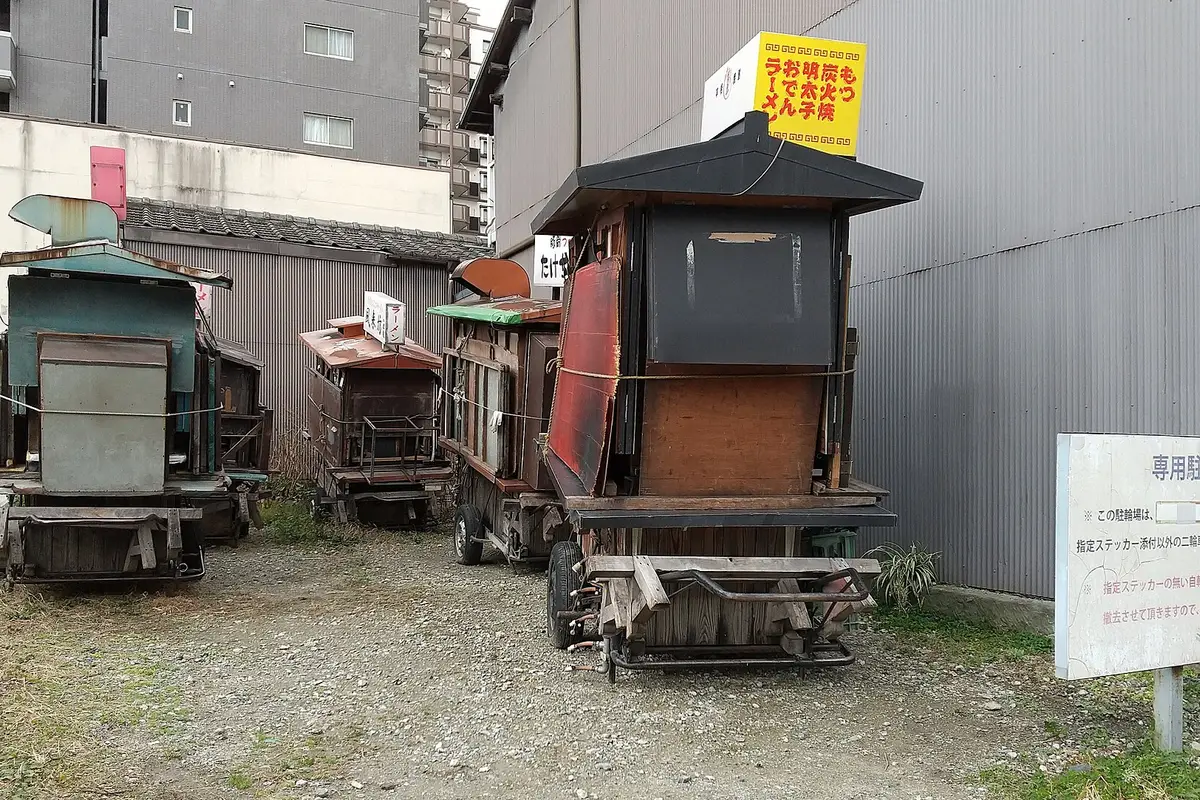
Most of those surprises have a dull official explanation, and the city publishes them. Stalls have no fixed closing day; each one rests when it likes, and some do not open at all in rain or storm. Most open between 6:30 and 7 p.m. and close around midnight. There are more than a hundred across the city, and the districts the city recruits stallholders for are Nakasu, Tenjin and Nagahama, so any one riverbank holds a modest row where the photographs promise a wall of lanterns. The whole trade runs inside a window the city licenses, 5 p.m. to 4 a.m., setup and teardown included, which is why the pavement is bare when you walk past the same spot in the morning.
The warmth in the green half is just as specific. Plenty of it is about the food: better than one in three of the positive yatai reviews says outright that something was delicious. A smaller group, roughly one in eight, writes about the talking. "The atmosphere at the yatai is good," one reviewer wrote, "but there are surprisingly many tasty things too. Drinking with good snacks while talking with strangers is fun in its own right." One lukewarm review comes from someone whose evening went perfectly well. The food came fast. The oden broth was good. And then: "it was a little disappointing that there was no interaction with local people."
Fukuoka's own tourist office says the same thing, in writing: "The joy of yatai is communicating with the staff and fellow diners sitting next to you. So be brave and try talking to them!"
Doing it well: the welcomed way
Most of what the reviewers regret can be arranged in advance, and the official guidance and the people who had a good night tend to agree on how.
- Go in twos or threes, or alone. Seating is tight, and a large group is the arrival most likely to be turned away. Reviewers of every party size also walk away from full stalls on ordinary evenings, so leave yourself a second choice. One Japanese solo traveler was waved straight into a free seat, though with the staff busy along the rest of the counter a full bottle of beer went by before the first plate arrived, and they decided they would bring a friend next time. The city recommends parties of two to three and says going alone is completely fine.
- Bring cash, and travel light. Most stalls take cash only; the city puts card acceptance at about one in ten. There are no toilets in a yatai, and no room for a suitcase, so leave the bags at the hotel or in a locker.
- Check the menu prices before you order, which is what the city advises, and think of it as a bar with food. Some bar-style stalls do run a cover charge. Reviewers who were surprised by the bill split two ways: some compared the per-item price with an izakaya, and others were startled by the total, one of them reporting close to 5,000 yen for two beers and three dishes. Order at least one drink and one dish each, which is the local courtesy, and plan on beer and a few plates rather than a full meal.
- Plan on about three stalls rather than settling into one. Visiting about three is what the city recommends, and it is the cheapest insurance against your first choice being shut. One reviewer did arrive expecting to graze and found that a yatai is somewhere you settle in and talk instead.
- Arrive early if you want to watch. One traveler's tip: "Try to head down around 3-4PM when they're setting up. It's unreal how small they are before they're unpacked."
- Say something, or don't. Talking to the cook and to whoever is beside you is what the city's own guide calls the joy of a yatai, and it is the thing the lukewarm reviewer above missed on an evening that otherwise went well. One traveler noticed the gentler version of the same thing about the city at large: "Less tourists so English is less widely spoken so speaking a small amount of Japanese will elicit large smiles." You do not need any of that to have a good night. A greeting and a nod are plenty, nobody expects fluency, and a beer, a plate and the noise around you is a perfectly good evening on its own.
- Give the daytime to the ordinary city. Daylight is where the disappointed travelers ran out of material, and where the warmest Japanese reviews are: the lake loop at Ohori Park, the shrine in the middle of Hakata, the tower, the mall. Nine in ten Japanese reviewers of those four places came away glad.
Two more things are worth knowing before you weigh the days. The airport sits inside the city, and the official guide puts it five minutes from Hakata Station and ten from Tenjin by subway, with the domestic terminal connected straight to the platform. And the stalls exist on purpose: Fukuoka wrote them into law in 2013 and now recruits new operators by public competition, most recently for 23 licensed pitches across Nakasu, Tenjin and Nagahama. The row of lanterns that appears at dusk and is gone by morning survives because the city built a framework to keep it.
So, is Fukuoka worth it? Seven in ten of those who made the trip say yes, and the reasons they give are food, pace, room to breathe and a short hop into the rest of Kyushu. The ones who hesitate are mostly weighing it against another city on the same days, and one of them, who has been more than once, still calls it a nice city and still says it is not a must-see place. If a famous view is what your days are built around, the amber band is the part of this page written for you. The slower pace and the food are what the seven in ten keep naming. The loud counter with a stranger's elbow beside yours is a smaller share of them, and it is where the Japanese reviewers, who know it best, are the most particular about how you go.
Working out how the big names stack up against each other? What actually matters in Japan collects the rest of these questions.
Sources
- Fukuoka City, About the Fukuoka City Yatai Ordinance (福岡市屋台基本条例について). The ordinance took effect on 1 September 2013 and sets out the duties of the city, the stall operators and the customers.
- Fukuoka City, Public call for yatai operators (福岡市屋台営業候補者の公募について). The current round covers 23 pitches in Nakasu, Tenjin and Nagahama; licensed hours run 5 p.m. to 4 a.m. including setup and teardown; stalls are capped at 3 m by 2.5 m; no raw food, no takeout or delivery; the licensed operator must be present throughout. Page updated 14 July 2026.
- Fukuoka City Official Tourist Guide, Fukuoka Hakata Yatai. Over 100 stalls open around the city at dusk; seating is limited and shared.
- Fukuoka City Official Tourist Guide, How to Enjoy Yatai. Opening times and irregular closures; no toilets; travel light; groups of two to three recommended and solo is fine; check the prices on the menu; most stalls are cash only with about 10% accepting cards; some bar-type stalls have a cover charge; one drink and one dish per person is the courtesy; visiting about three stalls is recommended; "the joy of yatai is communicating with the staff and fellow diners sitting next to you."
- Fukuoka City Official Tourist Guide, Getting to Fukuoka City. The domestic terminal connects directly to the subway; roughly 5 minutes to Hakata Station and 10 minutes to Tenjin (estimates).
- Jalan, guest review of a Nakasu yatai (Japanese). One reviewer reported two beers plus three dishes coming to nearly 5000 yen, written without a thousand-separator: 5000 yen, and said prices had climbed compared to before.
WMJS is written in Japan, in English, with AI help. We check every page, but English is not our first language. If a sentence reads oddly, tell us. One sentence is enough.
Thank you. A person reads every note.
How well do you know Japan?
Based on 51,218+ real Japanese voices
Want to know more? Ask Japanese people
Have a follow-up question about this topic? We'll ask real Japanese people.
Voice Box →