
Is the Biei Blue Pond Worth It? What Visitors Say About the Color That Isn't Guaranteed
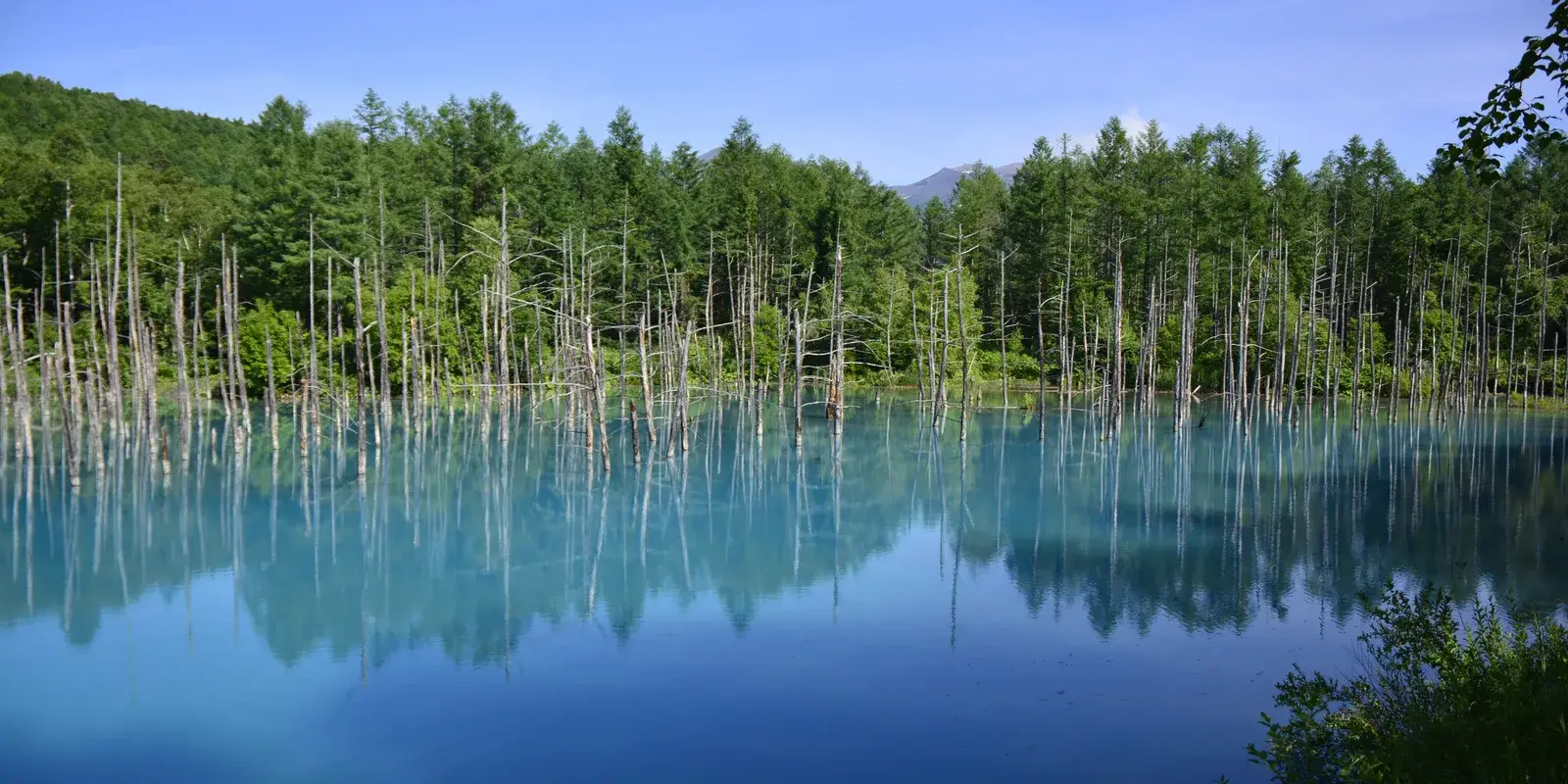
You have probably seen it before you ever plan to go: a pond of impossible turquoise, pale dead trees standing in the water, so still it looks retouched. It was a stock Mac desktop wallpaper for years, and that is exactly the picture in your head when you set aside a morning, rent a car or catch the bus, and drive out past the Biei hills to see it for yourself.
Then you arrive, and the water is grey.
Or it is not, and it is the most beautiful thing you see all trip. That is the honest whole of what visitors told us: the Blue Pond is worth the trip, but the blue is not guaranteed. The color is a lottery the weather and the light run every single day, so the trick is to stack the odds, and to plan a morning that is still good even if the pond is grey.
Was it worth the detour? (in visitors' own words)
We gathered the voices of international travelers who have actually made the trip out to the Blue Pond and asked, in effect, was it worth it? Weighted by how strongly each opinion resonated with other readers, here is how they fell.
Look at where the weight sits. The red bar is barely a sliver. Almost everyone lands on the middle bar, the biggest of the three, and that band is the most honest thing on the page: one sentence said over and over, that the pond depends on the day. One visitor from California put the whole page in two lines: "Amazing view and definitely unique, but it depends on the weather. It's perfectly beautiful if it's a sunny day, if it's not sunny, you don't get much to see."
That is why the small green group and the small red group are so often the same person on two different mornings. A traveler from London who caught rain wrote, without bitterness, "I don't think we got quite the full affect of the stunning blue, although it was still really quite spectacular," before landing exactly where most people do: "Think this would be really beautiful on a sunny day, well worth a trip out to it, if you're in the area." The handful of genuine let-downs almost always name something they could have known in advance. "Driving a long way there followed by queueing for car park may not be worth it if you have other plans," one wrote. "It's also not that big a place so you only spend a short time there." Both true. Neither a surprise, if someone tells you first.
How the people who live near it feel
Here is the layer most guides skip: what Japanese visitors say, in their own reviews, about the same pond. It is warmer, and it carries a more honest ache.
The Japanese red bar is a touch larger than the visitors' one, and it is worth sitting with, because it holds a grief that international reviews rarely reach. This pond was a local secret before it went viral. One longtime reviewer remembered it plainly: "Back when the Blue Pond wasn't known yet, you'd push through wilderness thinking a bear might come out of here, and have the empty Blue Pond all to yourself. Now there's a proper parking lot, the area is developed, it's become a tourist spot, and it's swarming with people." And then, in the same breath, the thing that keeps the green bar so tall: "But this mystical view of the Blue Pond hasn't changed in 30-odd years. Please, go see this scenery."
That is the honne, the real feeling under the polite one. The crowds are real, and the people who remember the quiet mourn it. The color still stops them cold anyway. The neutral band says the same weather truth the visitors do ("A few years ago on a cloudy day, the pond looked gray and dull," one wrote of a return trip), plus one thing the tourists tend to miss and the locals say out loud: it is small. "Smaller pond than I expected. People, people, people. I was surprised," one wrote, before adding, "But even so, it's worth seeing at least once."
What the pond actually is (and why it turns grey)
The single fact that makes everything else make sense: the Blue Pond was never designed to be beautiful at all, and its color is an accident of engineering. When crews built erosion-control works on the slopes of Mount Tokachi to protect Biei from volcanic mudflows, water pooled behind a dam, and that water turned an unearthly blue. One local reviewer only learned this on site: "it's largely connected to a mudflow from Mt. Tokachidake's eruption."
The color comes from the water itself. Upstream, the Biei River mixes with streams carrying aluminum from the Shirogane hot-spring area, and the fine particles scatter sunlight so that the short blue wavelengths reach your eye. Which is the whole reason it is a gamble. Sunlight is the ingredient. On a flat grey day the scattering has nothing to work with, and the town's own tourism office says it straight: after snowmelt in spring or heavy rain, the minerals dilute and the water can turn cloudy or lose its blue entirely. In deep winter it does not read as a pond at all. As one visitor found in December, "the pond was covered in snow and completely white. We couldn't see it at all."
The Biei hills carry the day
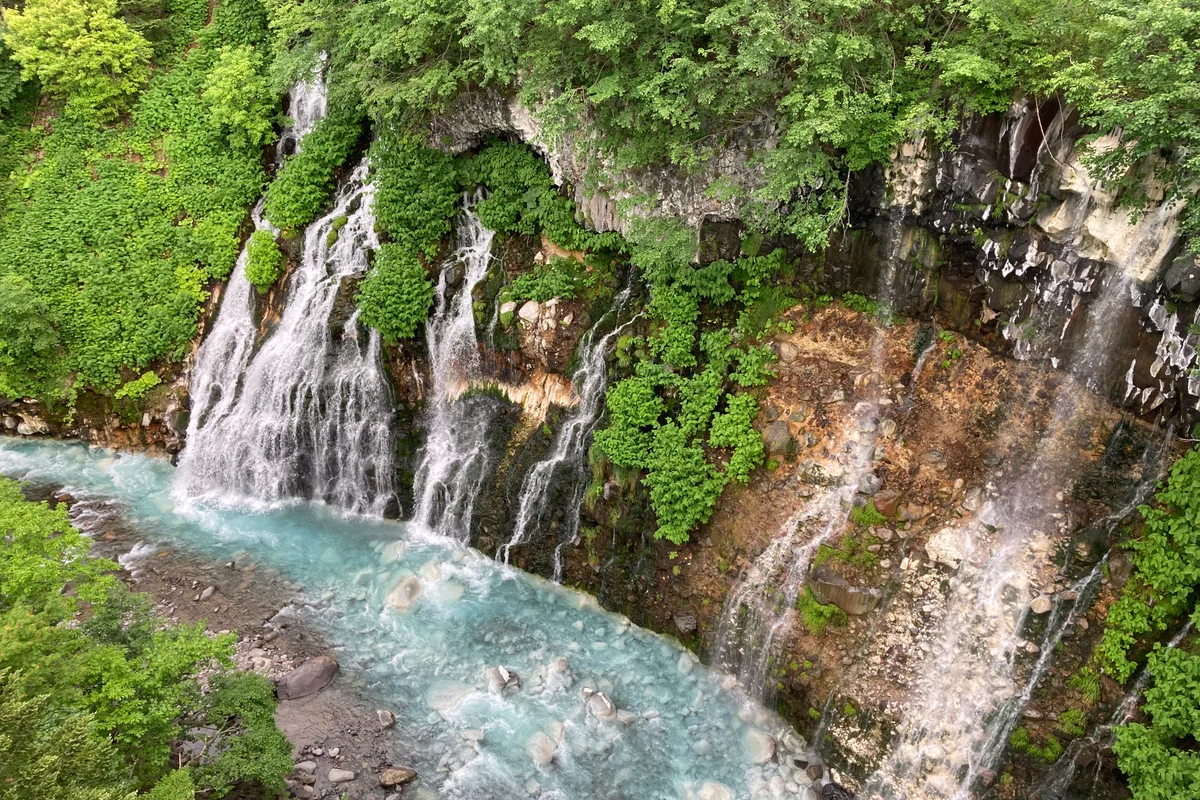
So here is how to make the trip worth it no matter what the pond does: do not stake the whole day on one pond. The Blue Pond is a fifteen-to-thirty minute stop, a short walk from the car park, and the smartest visitors treat it as one bead on a string. Just up the road is Shirahige Falls, the spring-fed waterfall whose blue-white water actually feeds the pond its color, and beyond it the patchwork hills, flower fields, and viewpoints that made Biei famous long before the wallpaper did. Those do not need a sunny miracle. They are lovely in flat light, in mist, in the low gold of early morning.
How to make the trip a good one
Everything above resolves into a few moves that turn a coin-flip into a good morning.
- Go in the morning, and go early. The color is best when the sun is up but the crowds are not, and the tour buses roll in from Sapporo and Asahikawa by mid-morning. "Go early in the morning before all the tourist bus from Sapporo and surrounding area packed the place," as one visitor advised. The car park opens around 7am; arrive near opening and you may have the boardwalk nearly to yourself.
- Give the odds a nudge. A clear or bright day is the whole game. If you can, check the forecast and aim for a bright morning; a flat grey day is the one outcome to dodge. Avoid the days right after heavy rain or spring snowmelt, when the town warns the blue can wash out.
- Set the size expectation now. It is a small pond and a short, flat walk of a few minutes. Plan around thirty minutes here and you will leave delighted; treat it as a half-day outing and you will leave puzzled.
- String it together. Pair the pond with Shirahige Falls and the Biei and Furano hills so the drive earns itself even if the water is grey. This one change is what separates the happy reviews from the disappointed ones.
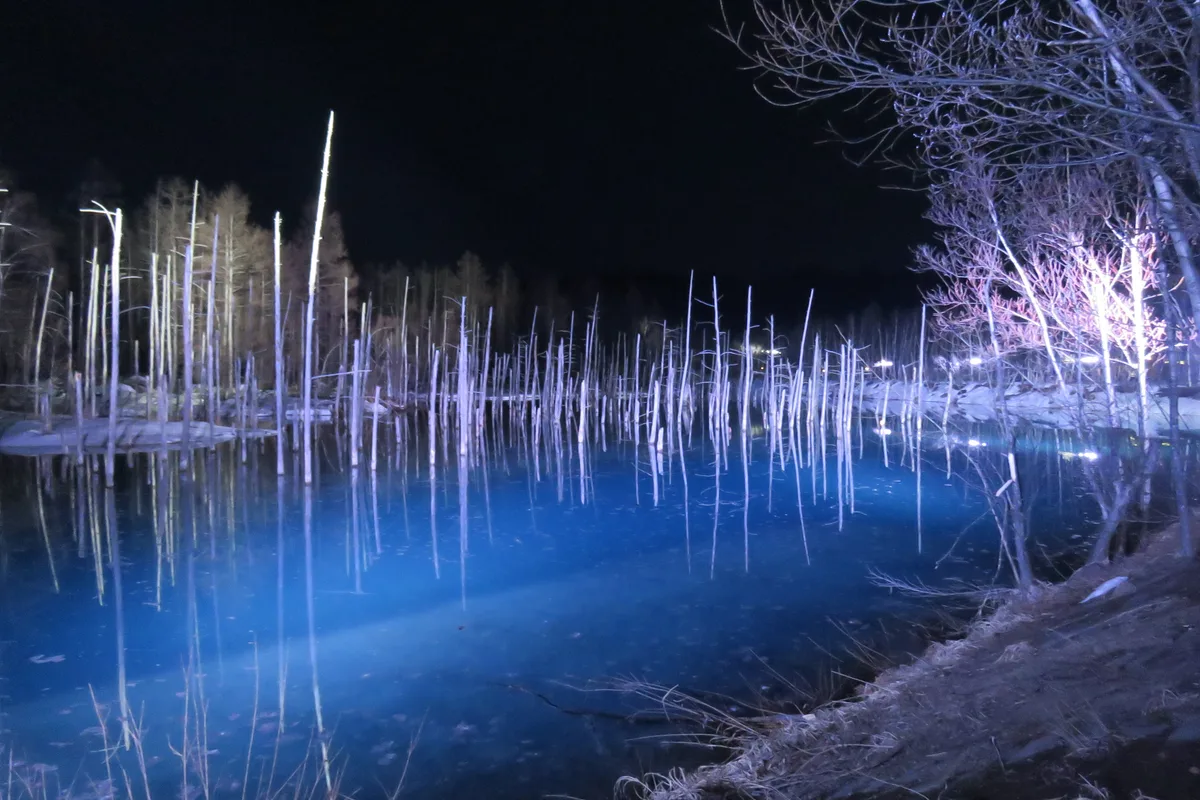
- Know what winter is. From roughly late autumn to spring the pond freezes and turns white by day, but on winter evenings it is lit up in blue and gold, a genuinely different and lovely thing. Come for the illumination on its own terms, the way people who plan a winter trip do.
- The practical bits. Entry to the pond is free; you pay only to park (a regular car is 1,000 yen as of July 2026, up from 500). It is about 20 minutes by car or route bus from central Biei, and there is a shop with blue soft-serve and restrooms by the car park.
Do these, and the day tends to go the way the delighted reviewers describe. The pond has no trick to it. It is simply a beautiful accident that depends on the sky, and the visitor who plans for a grey pond, and gets a blue one, is the one who drives away grinning.
Does it earn the drive? The color is never promised, the pond is smaller than the photos, and the quiet the locals remember is long gone. And still, on the right bright morning, a dam full of ordinary river water glows a blue you will hardly believe, in the middle of some of the loveliest countryside in Japan. Time the light, keep the drive full of other good things, and Biei will reward you for coming.
Still weighing which famous spots actually earn a place on a short trip? Start with what actually matters in Japan, and if you are building a Hokkaido route, see whether Hakodate and Otaru belong on it too.
Sources
- Biei Tourism Association: Shirogane Blue Pond (official): the pond formed when water pooled behind erosion-control works on Mount Tokachi; the blue comes from aluminum-bearing river water scattering sunlight; after snowmelt or heavy rain the water can turn cloudy or lose its blue; morning visits advised, with 1pm to 3pm the busiest on clear days; about 20 minutes by car or route bus from Biei Station.
- Biei Tourism Association: Blue Pond parking fee revision, effective 1 July 2026: regular-car parking raised from 500 to 1,000 yen (motorcycles 100 to 300 yen; large vehicles 2,000 to 6,000 yen); written without thousand-separators, that is 500 yen rising to 1000 yen.
- Biei Town: Shirogane winter illumination: the Blue Pond and Shirahige Falls evening light-up runs through the cold season, lit from sunset until 9pm.
WMJS is written in Japan, in English, with AI help. We check every page, but English is not our first language. If a sentence reads oddly, tell us. One sentence is enough.
Thank you. A person reads every note.
How well do you know Japan?
Built from 635 public posts by Japanese people
Want to know more? Ask Japanese people
Have a follow-up question about this topic? We'll ask real Japanese people.
Voice Box →