Okinawa, an easy few days
The old Ryukyu Kingdom's islands — Shuri, the reef coast, Churaumi and the sacred south — at a warm, unhurried pace
Last verified: 2026-06-16
Who this plan suits
- First tripWorks well
- Been beforeWorks well
- With kidsGreat fit
- SoloWorks well
- As a coupleGreat fit
- Gentle paceWorks well
Beach and reef season; you'll want a rental car, as there's no rail beyond Naha's monorail. Typhoons are most likely Aug–Sep.
Okinawa is the part of Japan that feels, gently, like somewhere else — and that's not a holiday illusion. For about four hundred and fifty years, until 1879, these islands were the Ryukyu Kingdom, an independent country with its own king, language, food and music, and that memory is still in everything: the red palace on the hill, the snakeskin sanshin in an evening bar, a bowl of soba that turns out to be nothing like the soba on the mainland. So I'd come for warmth in both senses — the subtropical light, and the welcome the islands call ichariba chōdē, once we meet, we are family. I'd hold this as a loose four-day frame: a day in Naha for the kingdom's old heart, a slow drive up the west coast, the far north for the famous sea, and the quiet sacred south on the way back to the airport.
The one thing that shapes everything here is that Okinawa has almost no train. Naha has a lovely little monorail, but it stops at the edge of the city — so the island's spine is a rental car, and the drive itself becomes part of the trip. I'll lay out how I'd move and where I'd sleep, with the carless option named honestly where it's hard, and you can pull the pieces apart and put them back together however your trip wants to go.
Where to base yourself
Okinawa's main island is long and thin — roughly a hundred kilometres from the southern tip up to the Motobu headland in the north — so where you sleep is really a question of how you'd rather split that distance. There's no wrong answer; it depends on whether you'd rather drive less or unpack once.
The simplest version is to base in Naha the whole time and day-trip out. Naha sits in the south, near the airport, and it's where the monorail, the food and the easy first day all are. The trade-off is the north: Churaumi and the famous coast are a long haul from the city (see the fact box), so a Naha-only trip means one big there-and-back driving day.
The version I'm fondest of splits the trip in two. I'd spend the first night or two in Naha for Shuri and the old city, then move up and sleep a night on the central-west coast — around Onna, the resort shore of beaches and reef, or further up near Nago / Motobu, close to Churaumi. That turns the brutal north day-return into a gentle one-way drive: up the coast, sleep by the sea, do the aquarium fresh in the morning, then drift back south. You drive the same road, but never twice in a day.
Then I'd come back to a Naha-area base for the last night, because the sacred south and the airport are all down here — so the final day loops out and back without ever retracing the north. Wherever you stay, the airport is the hinge: this is a trip that begins and ends in the south.
Getting around & tickets
The first thing to make peace with is that Okinawa is a driving island. Unlike Honshu, there's no rail network threading the towns together — so for everything beyond Naha, the honest answer is a rental car. Picking one up is straightforward, but the paperwork matters: to drive in Japan you need an International Driving Permit of the booklet type (the card and smartphone versions aren't accepted), and a few countries' licences need an official Japanese translation instead — I've put the specifics in the fact box, and it's the one thing to sort before you fly.
In Naha itself you don't need the car at all. The Yui Rail monorail runs from the airport straight through downtown to Shuri, so the whole first day — castle, Kokusai-dōri, dinner — is doable on the monorail alone, and a 24-hour pass pays off quickly if you're hopping on and off (fares and pass prices in the fact boxes). I'd pick the car up the morning I left the city, not the moment I landed.
The carless north, named honestly: if you'd rather not drive at all, you can reach Churaumi by express bus, but it's about three hours each way for what is essentially one destination — a long day for a single stop. It's doable, and I'd never tell you not to, but I'd want you to know it's the hard way before you choose it. With a car the same trip is around two hours, on the Okinawa Expressway (a NEXCO West toll road that runs much of the island's length; cash, card or ETC all work at the gates).
One small, lovely thing wherever you go: you'll see shisa on the rooftops — paired guardian lions, one mouth open to drive off harm, one shut to keep good fortune in. They're not decoration so much as a habit of care, and once you start noticing them you won't stop.
Naha — the kingdom's hill

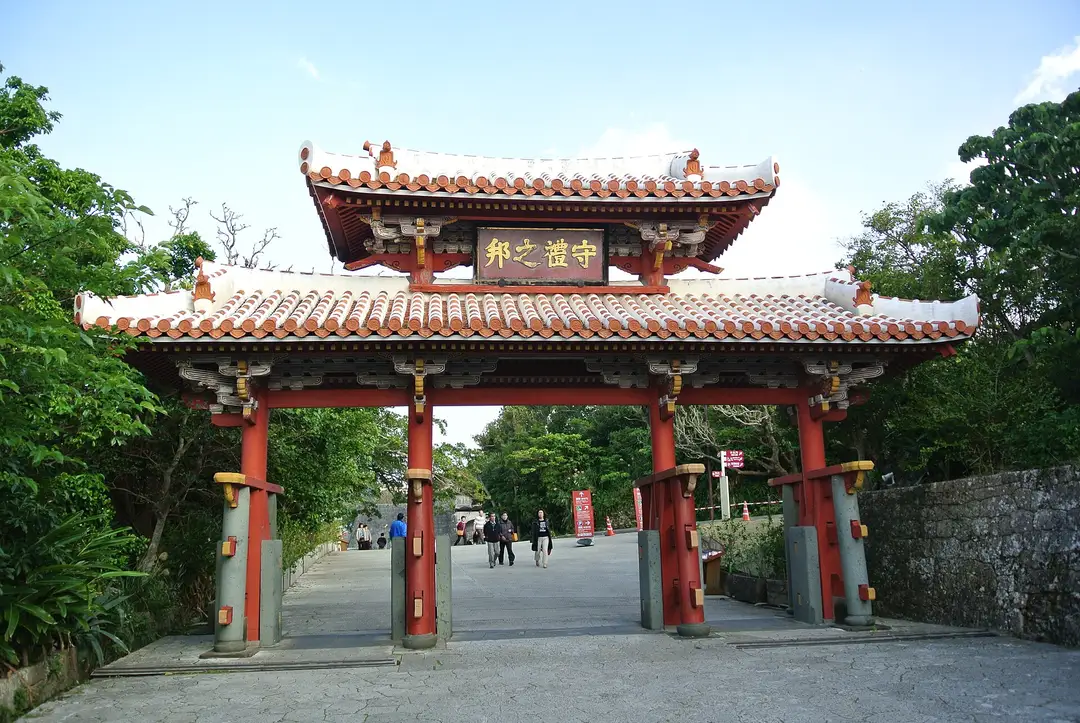
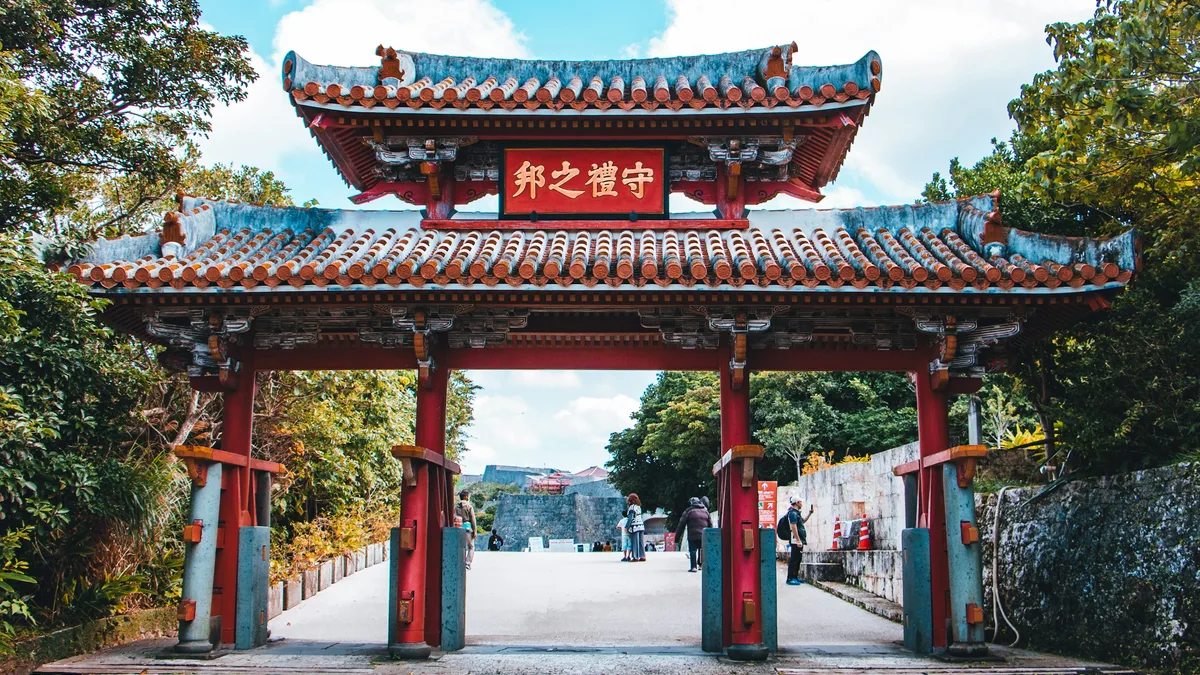
I'd give the first day to the city and skip the car entirely. The anchor is Shuri Castle, the red palace above Naha that was the heart of the Ryukyu Kingdom — its residence, its government and its religious centre, all at once. It's worth knowing before you go that the main hall burned in 2019 and has been rebuilt board by board (the work was expected to finish around autumn 2026, so it's worth checking where things stand when you visit) — and that the park deliberately turned the rebuilding itself into something you can watch from purpose-built decks. The old stone walls and World Heritage foundations were here long before the hall, and they're here still. From the hill I'd drift down into the city, and let the evening belong to a plain shop with a sanshin playing.
- 09:00Up to Shuri on the monorailFrom central Naha (or straight from the airport) the Yui Rail monorail runs to Shuri Station, then it's about a 15-minute walk up to the castle. You enter through the Shureimon — a vermilion gate with no doors, built to welcome rather than defend. Walk the same approach the kings climbed, and watch the hall coming back together. Linked guide: Okinawa (it tells the castle's full story).
- 13:00Kokusai-dōri and the pottery laneBack down the monorail to the Kencho-mae / Makishi stretch for Kokusai-dōri, Naha's long main street of shops and stalls. A few minutes off it is the Tsuboya yachimun (pottery) lane — quieter, older, the kilns that have shaped Okinawan ware for centuries. Wander, don't rush.
- EveningOkinawa soba and a sanshinFind a simple place for Okinawa soba — wheat-flour noodles in a pork-and-bonito broth, nothing like mainland buckwheat soba, and all the better for it. If there's a three-stringed sanshin playing, even better; the scale sounds like nowhere else in Japan. This is the kingdom's table, and the easiest way to feel the difference the day's been hinting at.
Up the west coast

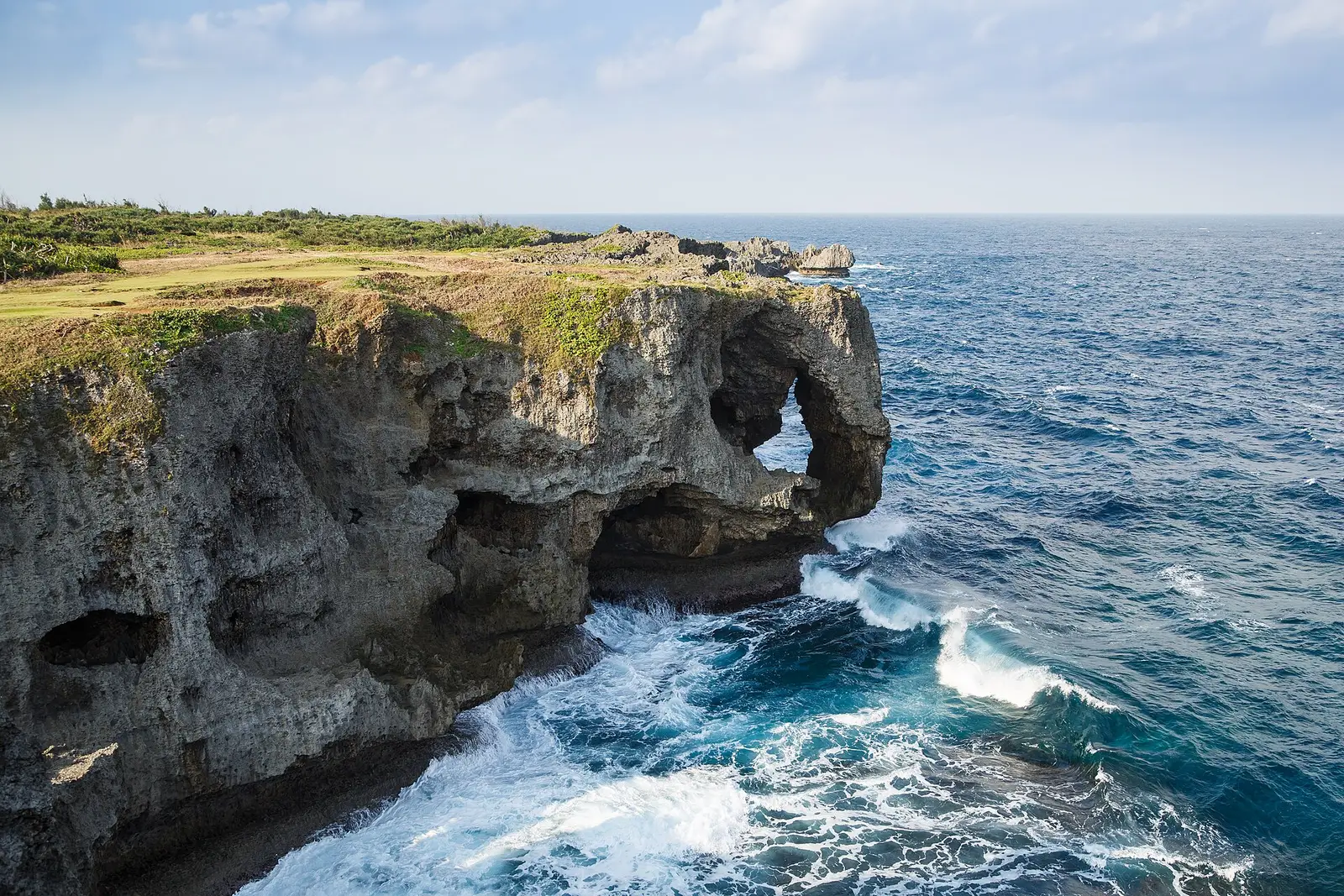
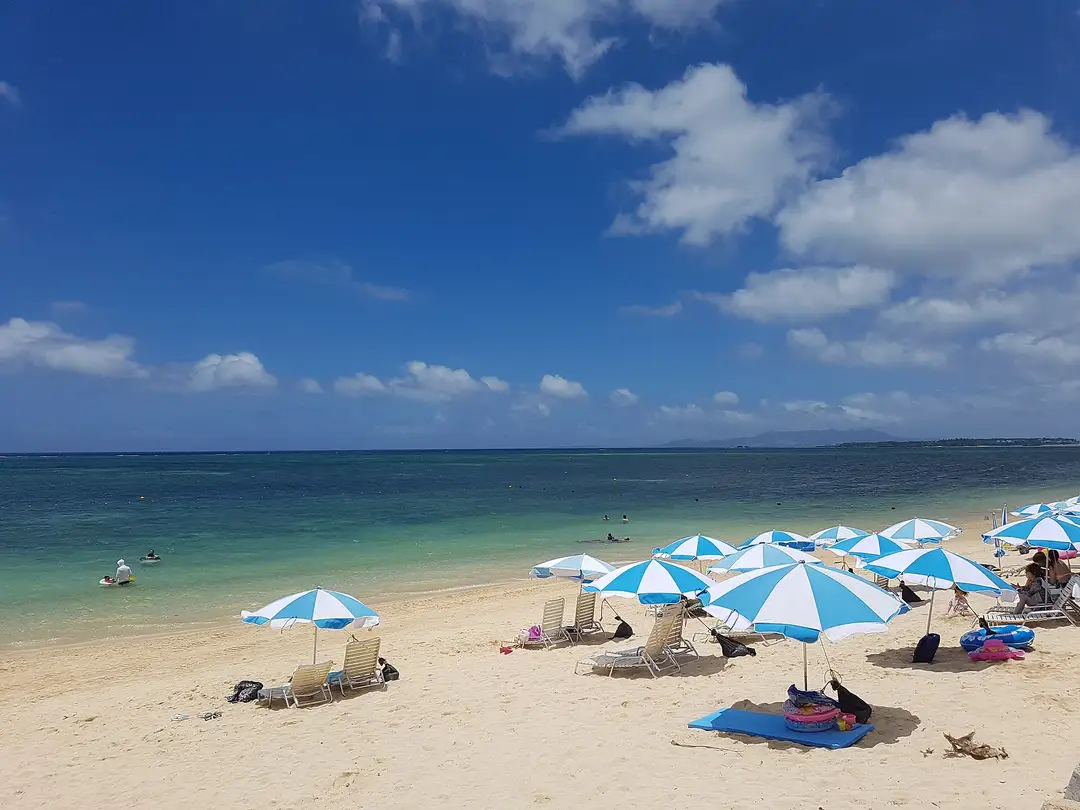
Today I'd pick up the car and let the drive be the point. The central-west coast — the Onna shore — is the Okinawa of the postcards: reef-flat water in impossible blues, headlands of raised coral, beaches that open for swimming as early as March. There's nothing here you're obliged to tick off, which is rather the freedom of it; you can pull in wherever the water looks its bluest. A natural one is Cape Manzamo, a coral cliff shaped like an elephant's trunk with the open Pacific beyond it. I'd take the coast road where I had the time and the expressway where I didn't, and aim to sleep somewhere up here — by the water, halfway to the north — so tomorrow's aquarium is a short hop rather than a marathon.
- MorningCollect the car, head northPick the car up in Naha and drive up the west side. The fast way is the Okinawa Expressway; the pretty way is Route 58 along the coast. Onna village, the resort stretch, is roughly an hour from Naha — a good first leg. (Honest note: this coast has no WMJS guide yet, so I'm pointing you up it rather than linking one.)
- AfternoonThe reef coast and Cape ManzamoStop where the sea pulls at you. Cape Manzamo's coral headland is the classic viewpoint; the Onna beaches are for simply standing in the shallows. The water here is warm and clear for much of the year — this is the warm-weather heart of the whole trip.
- EveningSleep by the seaI'd overnight up here — around Onna, or further on toward Nago/Motobu if you want to be near Churaumi for the morning. Splitting the drive across a night is the single thing that turns the north from a hard day into an easy one.
Churaumi and the far north

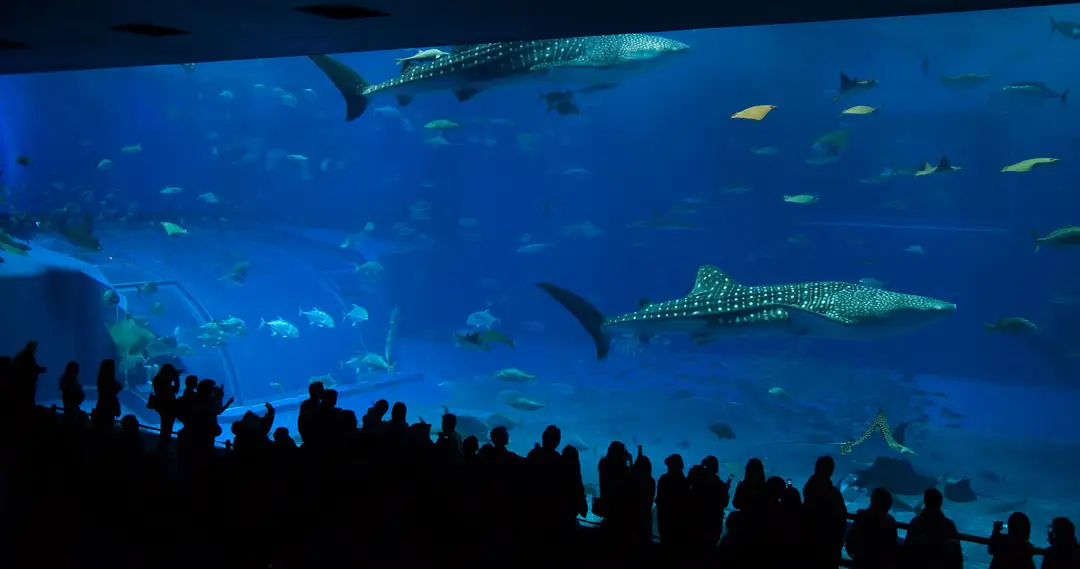
The north is where most of Okinawa's famous coastline lives, and its centre is the Churaumi Aquarium on the Motobu headland, inside Ocean Expo Park. It's built around one enormous tank — the Kuroshio Sea, named for the warm current that once made these islands a highway for ships — with whale sharks and manta rays moving behind an acrylic window over eight metres tall. I'd sit on the floor in front of it for a while; it rewards stillness more than photographs. Around it the north has its own quiet pleasures — the Bise fukugi tree avenue near the park, the bridge out to little Kouri Island — and then it's the long, sea-and-sugarcane drive back south.
- 09:00Churaumi Aquarium, earlyFrom an Onna or Nago/Motobu base it's a short drive to Ocean Expo Park (parking is free). Go early for the Kuroshio tank before it fills. The same whole-island Okinawa guide tells the story of why this sea, and this current, matter to the kingdom. (There's no standalone northern-Okinawa guide yet — this is the one to read.)
- MiddayBise fukugi avenue or Kouri IslandNear the park, the Bise no Fukugi Namiki is a lane roofed by old fukugi trees — cool, green, slow. Or drive over the long bridge to Kouri Island for the reef water from another angle. Either is a gentle counterweight to the aquarium crowds.
- AfternoonThe drive back southThen it's the road back toward Naha — about two hours by car on the expressway (the bus, if you're carless, is nearer three each way for this one stretch, which is why I'd lean toward driving the north). Aim back to a Naha-area base for the last night.
The sacred south, on the way out

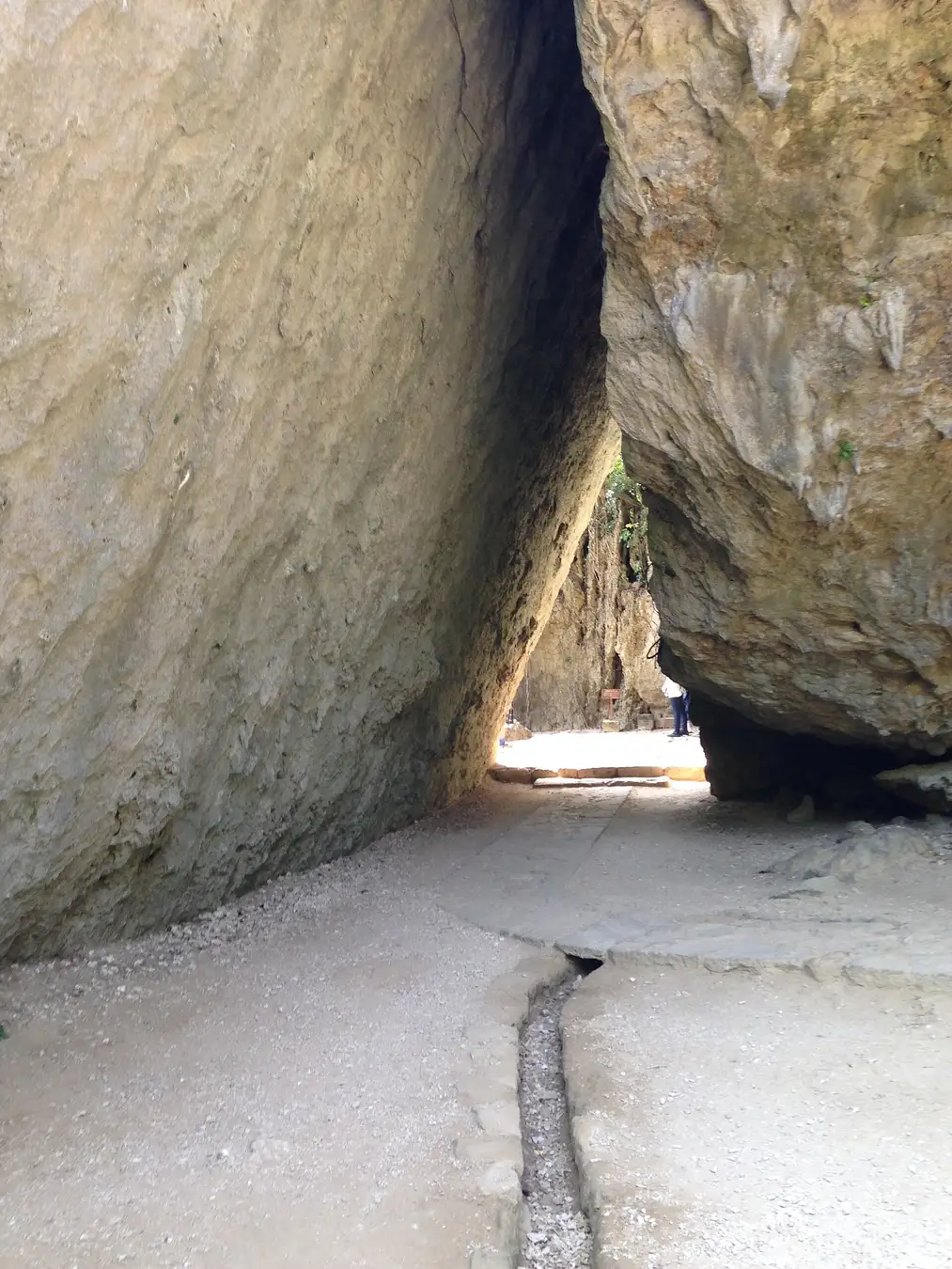
The southern tip of the island, just below Naha, holds the two quietest and most moving stops — and the geography is kind, because both sit between the expressway and the airport, so you visit them on the way to your flight without ever doubling back. Sefa-utaki, in Nanjo, was the supreme sacred site of the whole kingdom — a forest of rock and shadow where the islands' highest priestess once presided, now a UNESCO World Heritage place to walk softly through. And the Peace Memorial Park at Mabuni, where the Battle of Okinawa ended in 1945, holds the Cornerstone of Peace — black granite arcs inscribed with the names of everyone who died here, of every nationality, without separating one side from the other. It's a sober, generous note to end on, and then the airport is minutes away.
- MorningSefa-utaki, the sacred forestDrive south from Naha to Sefa-utaki in Nanjo (about 40 minutes). It's a sacred grove, not a built shrine — a path through huge rocks to the famous triangular stone gateway, with the offshore island of Kudaka, the kingdom's mythic birthplace, visible through the trees. Walk it quietly; it's still a living sacred place. (No WMJS guide for the south yet, so I'm naming it rather than linking.)
- MiddayPeace Memorial Park, MabuniOn to the headland at Mabuni, Itoman. The park grounds and the Cornerstone of Peace are open and free; the Prefectural Peace Memorial Museum tells the story of the battle and the islands' long road back. Give it time — it asks for it.
- AfternoonDrop the car, fly outFrom the south it's a short run back to Naha Airport — drop the rental and check in. Because the south sits between the expressway and the airport, this whole last day flows one way, ending where the trip began.
If you have one more day
+1 dayIf you've got an extra day, I'd offer two very different directions, and neither is the 'right' one.
Out to the Kerama Islands. A cluster of small islands a fast ferry-ride west of Naha (from Tomari Port), the Keramas are a national park famous for the clarity of their water — locals call the colour Kerama blue. It's a day on a boat and a beach, and a complete change of pace from the driving. Mind the ferry timetables, which thin out off-season.
Or central Okinawa, the layered middle. Between Naha and the resort coast sits the island's modern story: Katsuren Castle, a hilltop gusuku ruin with World Heritage status and huge sea views, and the seaside town of Chatan (American Village), where the long postwar American presence shows up as diners, surf shops and a Ferris wheel by the water. It's the Okinawa that isn't ancient and isn't a beach — the one that explains the island's last eighty years.
If you're short a day
−1 dayIf you're short on time, the trip folds down without losing its heart — and the kind way to do that is to pick one direction, not to cram both ends in. I'd keep the Naha day (Shuri and Kokusai-dōri, all on the monorail, no car needed), then choose: either drive north for Churaumi and the famous coast, accepting it as one long day, or stay south for Sefa-utaki and the Peace Park, which are gentle and close. Trying to do the far north and the deep south in a rushed two days turns the holiday into a steering wheel. A slow half of Okinawa is warmer than a hurried whole — there's no prize for collecting all of it.
Extend from here
OnwardThis is a warm-weather bookend block, and the thing that makes it different from the others is that it doesn't snap onto a rail line — it snaps at the airport. From Naha you fly back to the mainland: roughly two and a half to three hours to Tokyo (Haneda) to begin a Kanto block, or about an hour and three-quarters to Fukuoka for the Kyushu block. And the far outer islands — Miyako and the Yaeyamas (Ishigaki, Iriomote, Taketomi) down in the southwest — are a whole separate trip of their own, reached by another flight, not folded into the main island. I'd treat Okinawa as the trip you arrive into and leave from, rather than a stop you pass through.
Good to know — fares & times
Combine with another plan
Sources
- Okinawa Urban Monorail (Yui Rail) — official (fares, route, passes)
- Okinawa Churaumi Aquarium — official (access, fee)
- JNTO / Japan.travel — Things to know when renting a car (IDP rules)
- Okinawa Prefectural Peace Memorial Museum — official (Mabuni, Itoman)
- Be.Okinawa / Visit Okinawa Japan (OCVB official) — Ryukyu Kingdom 1429-1879 & Gusuku Sites World Heritage (2000)
- JNTO — Kokusai-dori (Naha's ~1.6 km main street; shisa lions)
- JAL — domestic route timetable (flight times off Okinawa)